Why Consistently Following a Trading Plan Is So Difficult — Even When You Know It Works
One of the greatest paradoxes in trading is this:
Most traders intellectually understand that consistently following a proven trading plan gives them the best probability of long-term success… yet many still struggle to do it.
If you consistently take high-probability setups defined in a validated trading plan, the odds are on your side. Over time, results tend to reflect that statistical advantage. That is trading like a business — structured, methodical, and repeatable.
However, if you frequently violate your trading rules, override your analysis, or chase random price action, you are likely producing inconsistent results punctuated by occasional lucky streaks. That approach is closer to gambling than professional trading.
Most traders do have a trading plan. Many have invested significant time validating it through technical analysis, multi-time-frame trend alignment, support and resistance evaluation, price pattern confirmation, and position and money management rules.
So if the plan is solid, why is consistent execution so difficult?
The answer lies in the psychological battle every trader faces.
The Hidden Enemy: The Waiting Game
One of the most challenging aspects of trading is not entering trades — it’s waiting for the right ones.
Markets constantly move. Prices fluctuate, headlines trigger volatility, and charts present endless opportunities that appear tradable. But a professional trading plan defines specific criteria that must be met before capital is committed.
Many traders experience this familiar situation:
A high-odds setup exists in their plan.
The market is moving.
But the setup is not fully formed.
When this happens, there is no trade.
And when there is no trade, there is no potential profit.
That is where discipline begins to erode.
Patience becomes uncomfortable. Confidence may start to weaken. The temptation to trade something — anything — grows stronger. Traders begin rationalizing marginal setups or convincing themselves that “this one looks close enough.”
That moment is where consistency breaks down.
The Brain Is Wired to Resist Trading Discipline
Following a trading plan requires behavior that runs directly against natural human instincts.
Humans Crave Certainty
Traders want reassurance that each trade will work. Unfortunately, trading is a probability business, not a certainty business. Even the best setups lose.
This uncertainty can create anxiety, leading traders to override their rules in search of confirmation or faster gratification.
Humans Seek Action
Doing nothing feels unproductive. In trading, however, inactivity is often the correct decision. Professional traders are paid for execution quality — not trade frequency.
Humans React Emotionally to Outcomes
Wins can produce overconfidence. Losses can trigger fear and hesitation. Both emotional responses encourage traders to deviate from their structured approach.
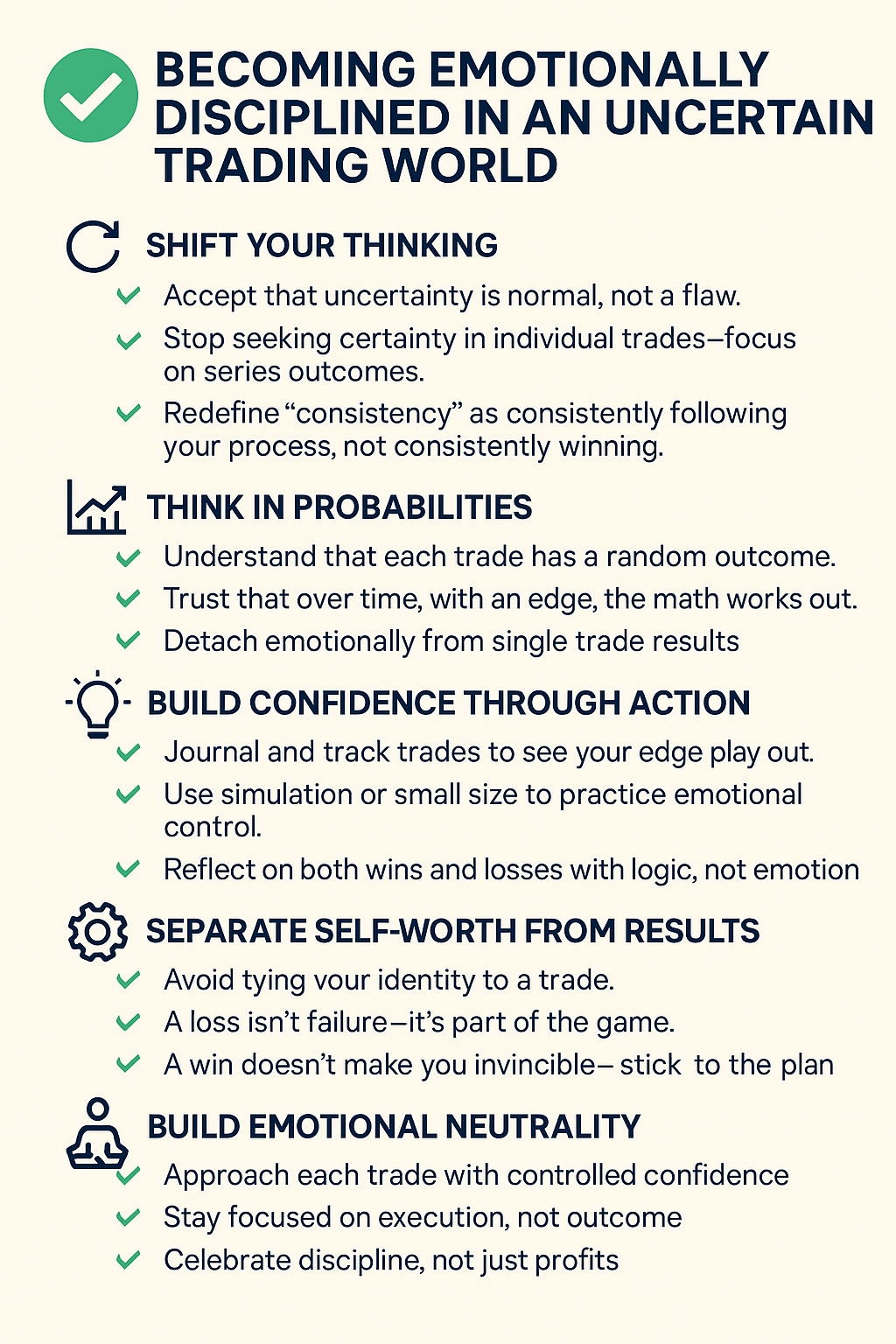
Confidence Is Built Through Process — Not Results
One of the most misunderstood concepts in trading is the definition of consistency.
Consistency does not mean winning every trade. That is unrealistic and mathematically impossible.
True consistency means consistently following your process.
When traders judge themselves solely by profit or loss, they begin to associate their self-worth with trading outcomes. This creates emotional instability, leading to impulsive decisions.
Professional traders measure success differently. They evaluate whether:
- The trade met the plan criteria
- Position size followed risk parameters
- Management rules were executed correctly
- Emotional discipline was maintained
If those factors are followed, the trade is successful, regardless of the outcome.
The Confidence Collapse Cycle
Even traders with strong education and proven plans experience confidence erosion. The cycle typically unfolds like this:
A series of valid setups does not trigger or produce losses.
The trader questions the strategy.
Impatience leads to off-plan trades.
Off-plan trades increase inconsistency.
Confidence declines further.
Ironically, abandoning the plan is what usually creates the losing streak — not the plan itself.
Trading Like a Business vs Trading Like a Casino
Professional trading resembles running a business. Businesses operate on repeatable systems, measured risk, and statistical expectations. Individual outcomes vary, but the process produces long-term profitability.
Gambling focuses on short-term excitement, emotional decision-making, and unpredictable outcomes.
Ask yourself honestly:
- Do I follow predefined criteria before entering trades?
- Do I size positions according to risk management rules?
- Do I track performance and evaluate execution quality?
- Do I accept losing trades as part of statistical expectancy?
If the answer is yes, you are operating as a professional trader.
If the answer is no, emotional decision-making is likely controlling results.
The Role of Position and Money Management
Even the strongest technical edge cannot overcome poor risk control. Position sizing and capital preservation are the foundation of consistent performance.
Money management serves several critical functions:
Protects trading capital during losing streaks
Stabilizes emotional responses to trade outcomes
Allows statistical edges to play out over time
Prevents single trades from damaging confidence
Without proper money management, traders place unrealistic pressure on individual trades, which magnifies emotional stress and increases rule violations.
Why These Psychological Struggles Are Normal
Every trader experiences emotional challenges. No level of experience eliminates them completely.
The difference between struggling traders and professional traders is not emotional immunity — it is emotional management.
Recognizing psychological pressure is actually a sign of progress. It means you understand trading requires discipline beyond technical analysis.
Building Emotional Discipline Through Structured Action
Traders develop consistency by reinforcing behavior, not by trying to eliminate emotion. Practical methods include:
Journaling trades to track execution quality
Reviewing setups across multiple time frames
Practicing smaller position sizing during uncertain conditions
Measuring success based on rule adherence
Accepting that patience is a core trading skill
Confidence grows when traders repeatedly see their edge work over a series of trades — not individual outcomes.
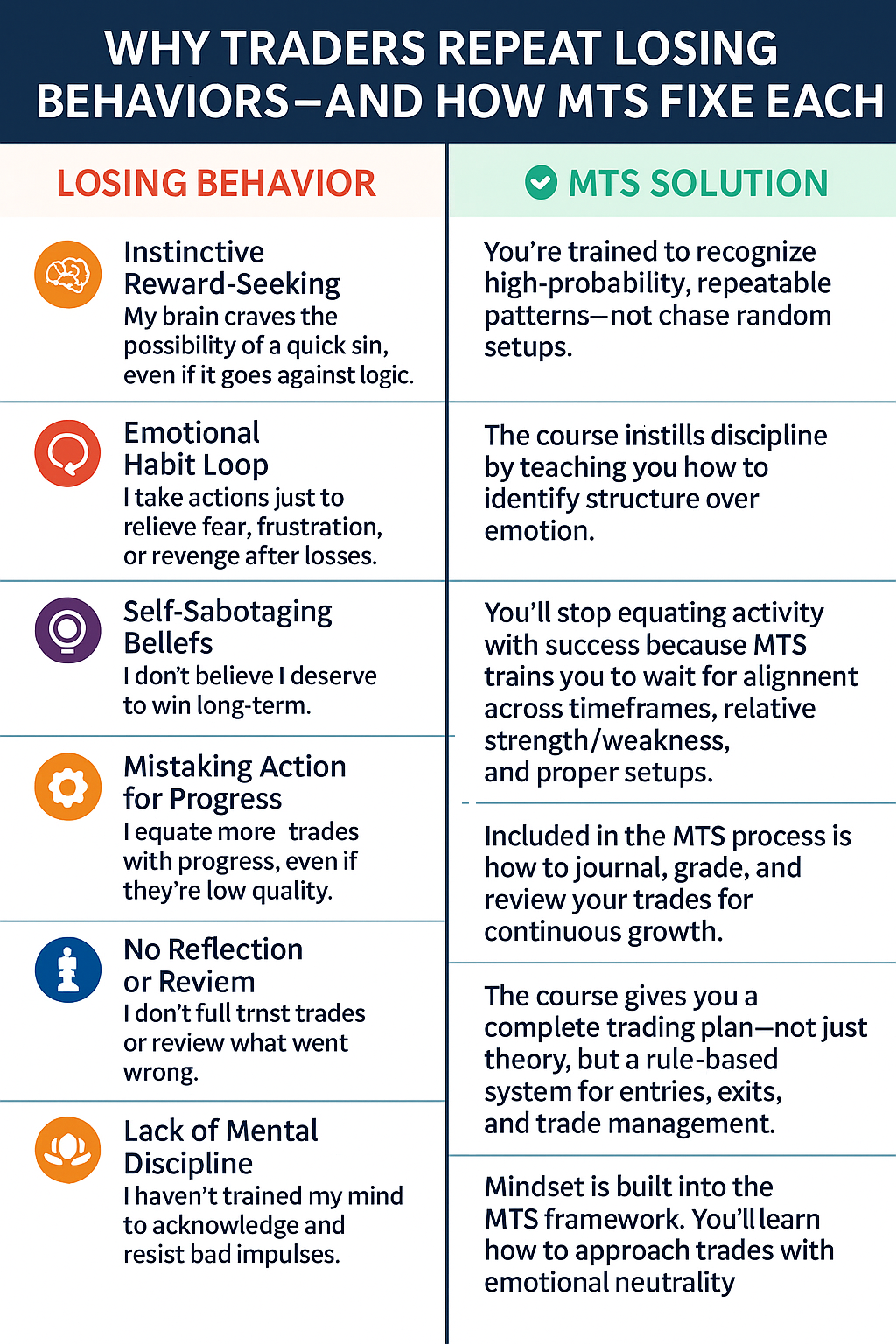
A Complete Trading Education Requires More Than Technical Analysis
Technical strategies identify opportunities. Management strategies protect capital. Psychological training ensures execution consistency.
All three components must work together to achieve long-term trading mastery.
Many traders focus heavily on chart patterns and indicators while neglecting emotional discipline and risk control. This imbalance is one of the primary reasons traders struggle to produce consistent results.
A complete trading education integrates:
Multi-time-frame technical analysis
Structured position and money management
Psychological performance development
When these elements align, traders can execute their plan regardless of market noise or emotional pressure.
Master Trader Thoughts
Consistently following a trading plan is difficult because it requires traders to act against their natural instincts. It demands patience during inactivity, emotional control during volatility, and trust in probabilities rather than certainty.
The struggle is universal. Every trader faces it – you’re not alone.
The difference between long-term success and repeated frustration is the commitment to process over impulse.
If you are following a structured trading plan, you are already ahead of most market participants. Discipline is not developed overnight — it is built through education, repetition, and experience.
Trading mastery is not just about finding great setups. It is about consistently executing them.
If you have found this post helpful, Share it Forward with other Traders
All the best
Greg Capra