Why Candlesticks Alone Often Confuse Traders—and How “Event Candles” Bring Clarity
Many traders come to candlestick analysis with high expectations. The books are clean. The examples are perfect. A hammer at the bottom leads to a rally. A shooting star at the top marks the high. Engulfing patterns seem to appear right before big moves.
Then reality hits.
You open a live chart, and suddenly the candles don’t behave the way they were supposed to. Bars overlap. Signals contradict each other. Red candles appear inside uptrends. Green candles appear just before the price rolls over. Instead of clarity, candlesticks start creating hesitation, second-guessing, and frustration.
This experience is not a failure on your part—it’s a limitation of how candlesticks are commonly taught.
The Core Problem: Candlesticks Without a Message
Most traders learn candlestick patterns as isolated shapes rather than messages. A single candle is treated as bullish or bearish, independent of what came before or what comes after. Even worse, traders are often told that simply placing these patterns “in the context of a trend” is enough.
It isn’t.
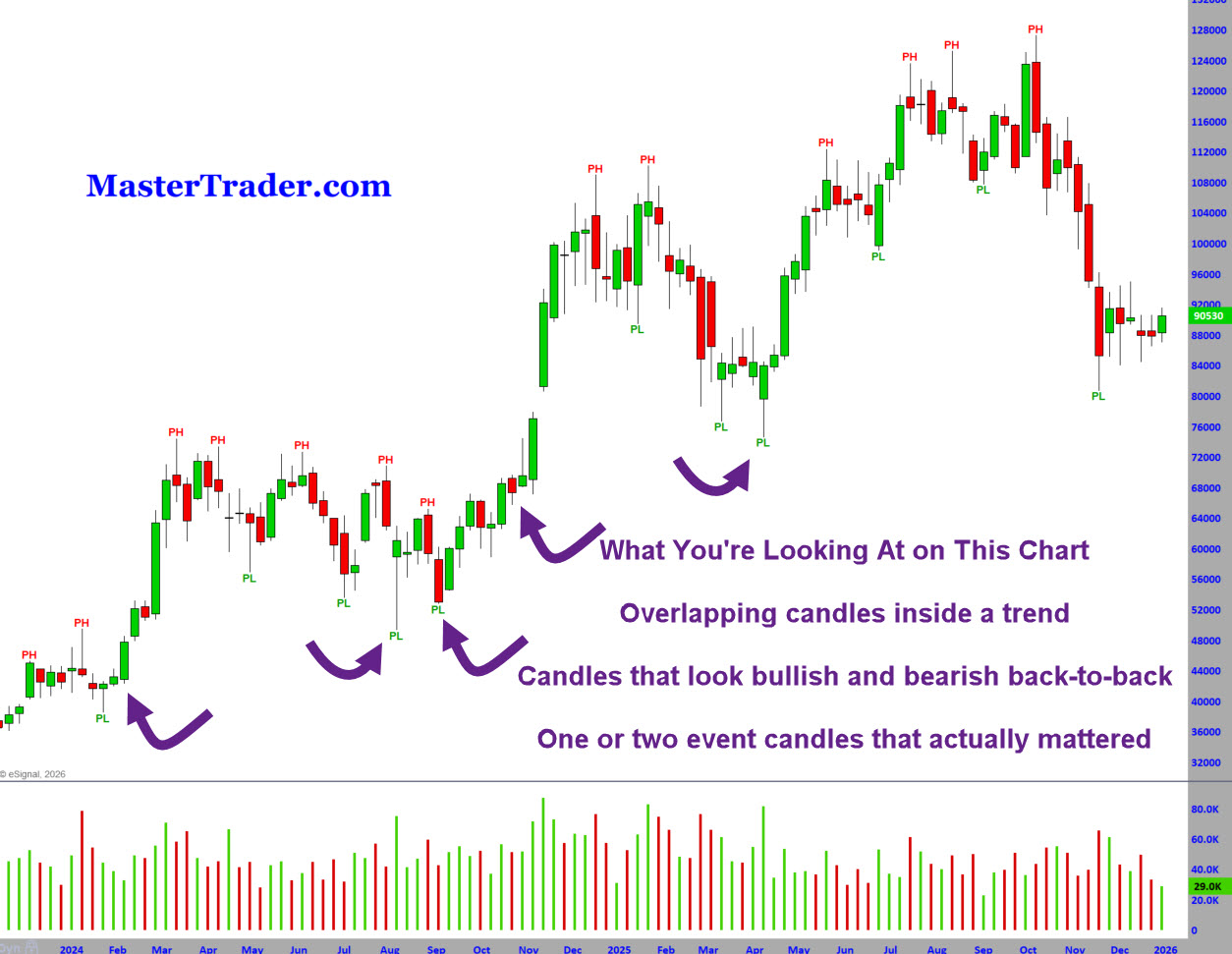
In real markets, candles frequently overlap each other—even within strong trends. You’ll see alternating red and green candles, small bodies, long wicks, and indecision bars stacked on top of one another. To a newer trader, this looks random.
And when everything looks like a signal, nothing feels reliable.
The result is predictable:
- Late entries
- Early exits
- Missed opportunities
- Emotional decision-making
This is where many traders begin to believe candlesticks “don’t work.”
But that’s not the truth.
The Missing Insight: Not All Candles Matter
What most traders don’t realize is that not every candle is important.
Markets print thousands of candles, but only a small percentage actually matter. We refer to these as event candles.
An event candle can be:
- A single candle, or
- A combination of up to three candles
To the untrained eye, these bars may look ordinary. To a trained eye, they jump off the chart because they change the behavior of price.
Event candles are not about memorizing names or spotting pretty shapes. They are about recognizing moments where:
- Control shifts between buyers and sellers
- Momentum expands or abruptly stalls
- Emotion becomes visible in price
Most candles simply fill time. Event candles move markets.
Candlesticks and Beyond this Wednesday at 12 ET. - Register HERE
Why Books and Websites Fall Short
Static examples in books and websites are frozen in time. They remove uncertainty, context, and decision pressure—the very things that make trading difficult.
Patterns are often shown:
- At perfect support or resistance
- With no surrounding noise
- Without risk management considerations
- After the outcome is already known
In live markets, patterns rarely look that clean.
Without a defined message for how candles work together, traders try to force meaning where none exists. A pattern that worked beautifully in a textbook becomes unreliable in real time because:
- The surrounding price structure is different
- The broader market context is ignored
- The candle appears in the wrong location
- Volatility conditions have changed
Candlesticks don’t fail—context does.
Candlesticks Are Not a Strategy
This is one of the most important realizations a trader can make:
Candlesticks alone do not create a trading strategy.
They are a component—not the foundation.
When event candles are combined with other Master Trader technical strategies, something changes. Suddenly, the candle is no longer a guess—it’s a confirmation.
This is where trading plans are built.
A complete trading plan answers:
- Why this opportunity matters
- Where risk is clearly defined
- Where price is expected to move
- What invalidates the idea
And just as important…
Why Even Great Setups Still Lose
Even the highest-quality event candles can fail.
Professional traders understand this and plan for it. That’s why every trading plan is paired with:
- Position sizing
- Defined stop losses
- Rules for adding to a trade
- Rules for scaling out
Risk is never an afterthought—it’s the foundation.
Instead of asking, “Will this work?” professionals ask:
- Is this high quality?
- Is this medium quality?
- Or is this something to stay away from entirely?
This filtering process is what separates consistent traders from frustrated ones.
Why This Brings Confidence Back
Once you understand event candles and how they function within a structured approach, several things change:
- Charts become quieter
- Fewer candles demand your attention
- Decisions become more objective
- Losses feel controlled rather than personal
You stop chasing every pattern and start waiting for your pattern—the one that aligns with your plan.
This is often the turning point for traders who have been stuck for years, wondering why “what they learned” never seems to work when it matters most.
See It Applied Live This Wednesday
This Wednesday at 12:00 PM Eastern, we’ll be presenting a new MasterTrader Live event where we go beyond candlestick theory and into application.
We’ll show you:
- How to identify true event candles
- How single and multi-candle events work together
- How to combine them with Master Trader concepts
- How to turn them into structured trading opportunities
- How professionals evaluate quality before risking capital
If you’ve ever felt that candlestick patterns made sense in theory—but not in real trading—this session will connect the dots.
Sometimes the issue isn’t that candlesticks don’t work.
It’s that no one ever taught you which ones matter—and why.
Greg Capra