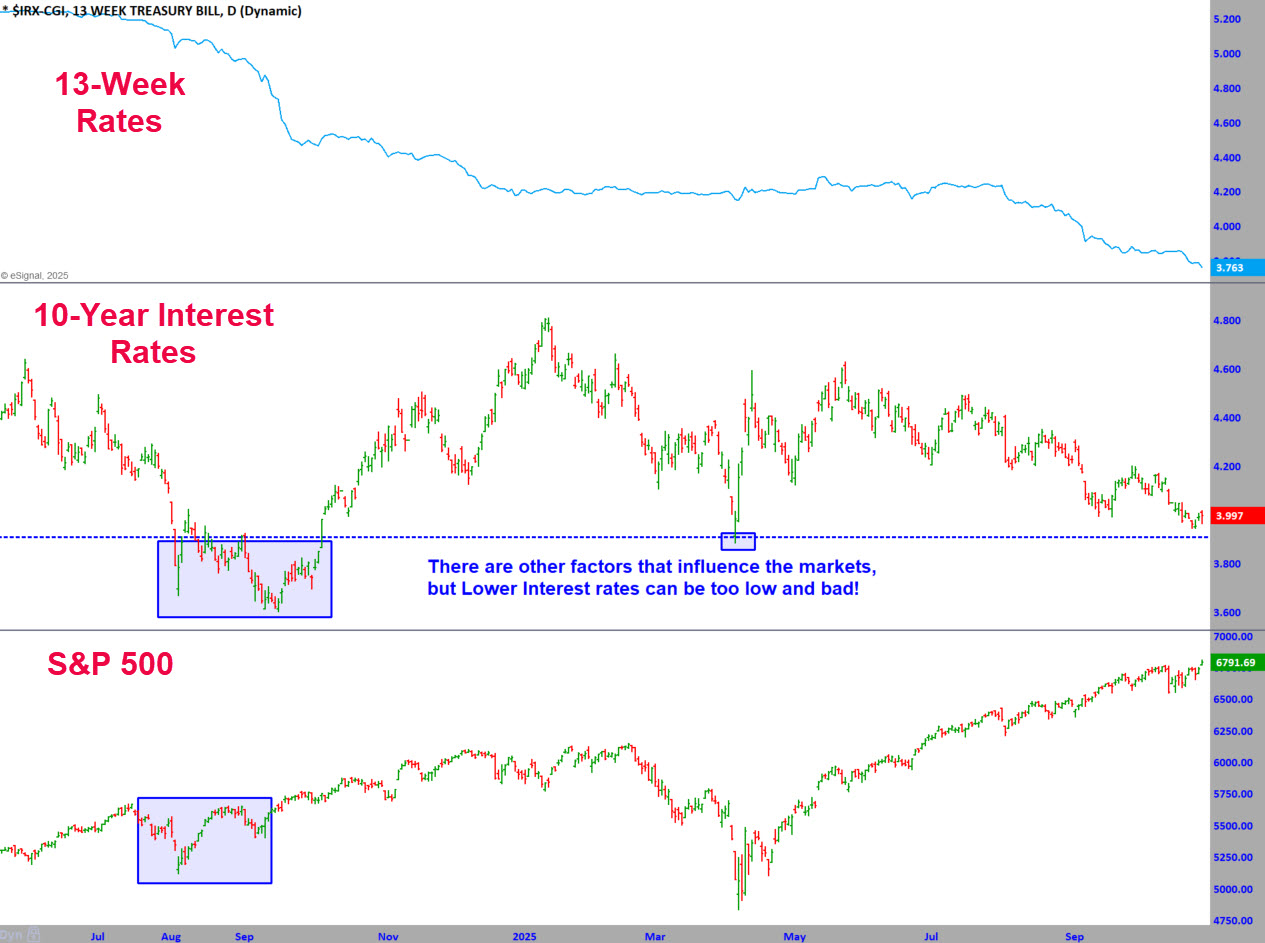
While lower interest rates generally support equities by reducing borrowing costs and raising valuations, there’s a point where falling yields signal fear rather than opportunity.
With the 10-year Treasury yield now below 4%—the same level reached near the stock market’s April low—the message from bonds may be shifting. If yields continue to decline, it could imply:
- Growth expectations are deteriorating, as investors flee to safety and price in slower economic activity.
- Earnings projections may be too optimistic, since lower yields driven by weak demand suggest future profit pressures.
- The “recession trade” (buy bonds, sell cyclicals) could re-emerge, weighing on Financials, Industrials, and small caps.
In other words, moderate yield declines help support equities —when does it become a concern?
Sharp or persistent drops can reflect fear of a hard landing. The sweet spot for the market is when yields are falling because inflation is easing (now), not because growth is stalling.
Master Trader Techno-Fundamentals
Master Trader Education: Why Stronger Growth Pushes Interest Rates Higher
When the economy begins to show renewed signs of growth, demand for money naturally rises.
We want to see interest rates stabilize now and, in time, begin to rise slightly.
Businesses borrow more to expand, consumers increase spending, and investors rotate out of bonds and back into risk assets like equities.
That shift creates two effects:
- Bond prices fall as investors sell Treasuries in favor of higher-return opportunities.
- Yields rise to reflect stronger economic activity and the market’s expectation that the Fed will eventually slow or reverse its rate cuts.
In other words, rising interest rates in a growth phase aren’t a sign of trouble—they’re a confirmation that demand is returning and the economy is heating up.
Traders watching intermarket relationships, which we do in the Advisory Swing and Options Trader Letter, should recognize that when rates rise for the right reasons—growth, not inflation—it often supports cyclical sectors such as Industrials, Financials, and Consumer Discretionary.
The 50% discount for the new course ends at the end of this month, when the price doubles. Click here.
Why choose Master Trader for your Financial Future?