

Technical analysis is used by millions of institutions and self-directed investors and traders like us.
The goal of using technical analysis is to be able to increase the odds of forecasting the future direction of prices.
How any institution or individual uses technical analysis through an indicator-based methodology is a choice.
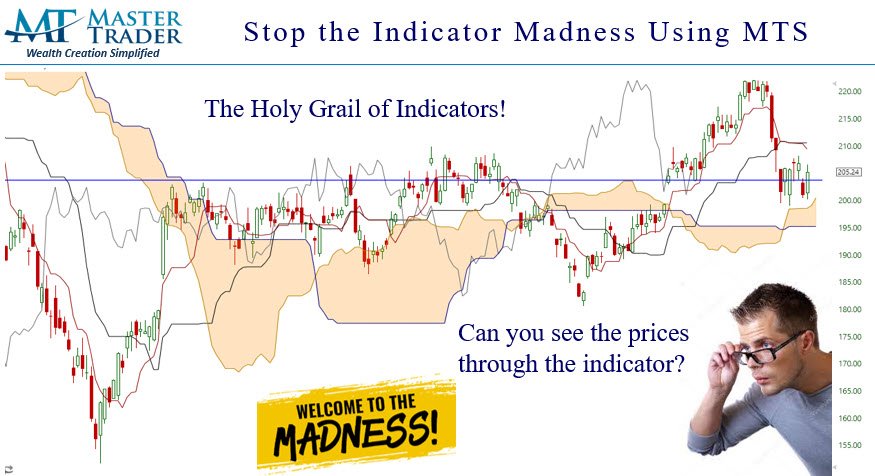
The number of indicators, the combination of them and their individual settings makes the choices endless.
Anyone opening a charting platform for trading today has a daunting task to figure out the right indicators -- or combination thereof -- and their settings.
For most, this leads to uncertainty about whether you’re using the right information, and when you think you are -- a lack of consistency leads to self-doubt.
Beware of the Technical Analysis Indicator Salesmen
As you search the Internet for the right technical analysis tools, you are going to come across an army of salesmen with indicators to sell you.
Once you buy one, there will be another indicator following that has better analysis to increase your profitability.
Upgrade to an add-on to the one you already bought. You've seen it.
You will see many examples where these proprietary indicators got you into the trade precisely at the right time.
And maybe it even got you out at the top.
There will be times when it works for you, but as you move from one tradable instrument to another, or the market environment changes, you will be lost.
How You Can be Using Technical Analysis to Level the Playing Field.
At Master Trader, our method is based on basic technical analysis principles.
Those principles are based on supply and demand created by institutions and individuals acting on their beliefs about the future with their money.
The basics of technical analysis starts by defining the trend of prices.
Are they moving up, down, or sideways? I will explain in the detailed video below.
You don't need any technical analysis tools like trendlines, Fibonacci lines, channels, or other more esoteric analysis tools.
Here are a few steps that will work on any tradable instrument in any timeframe.
Step one: Define the beginning of a turning point.
At Master Trader, we define the beginning of a turning point as a "Pivot."
A Pivot High (PH) has three lower high bars to the pivot bar's left and right.
A Pivot Low (PL) has three higher low bars to the pivot bar's left and right.
Step two: Define the trend.
If the pivots make higher high (HH) and higher low (HL) pivots, the trend is up.
If the pivots make lower high (LH) and lower low (LL) pivots, the trend is down.
If the pivots are opposing each other, the trend is sideways.
Step three: Define when the trend has changed.
An uptrend is over when the definition of an uptrend no longer exists.
A break below the prior PL in an uptrend has broken the series of HHs and HLs.
The uptrend is broken, and the trend has moved sideways.
A break above the prior PH in a downtrend has broken the series of LHs and LLs.
The downtrend is broken, and the trend has moved sideways.
A violation of either will break a trendline -- if you were to draw one connecting the pivots.
Realize that you can connect dots and prices can break a trendline that will not violate the trend.
Remember, our Definition of an Uptrend is HHs and HLs.
If prices have Not made HH but have created a new PL, connecting PLs with a line -- and breaking the line will violate the trendline, but Not the violate the uptrend. Watch the video below.
So, there is no reason to draw diagonal lines -- connecting dots.
You now have a black and white definition of when a trend ends.
If you are using the failed indicator based method of technical analysis, it's time that you made the change?
Successful traders only need a few compelling patterns to generate profits and wealth through trading and investing in the markets. It then becomes your job to wait for those setups, and execute and manage with property money and trade management using the Master Trader Method!
Master Trader and You Building Your Financial Future Together!
Happy trading! If you have any questions or comments, please e-mail Greg Capra at Greg@mastertrader.com or Dan Gibby at Dan@mastertrader.com