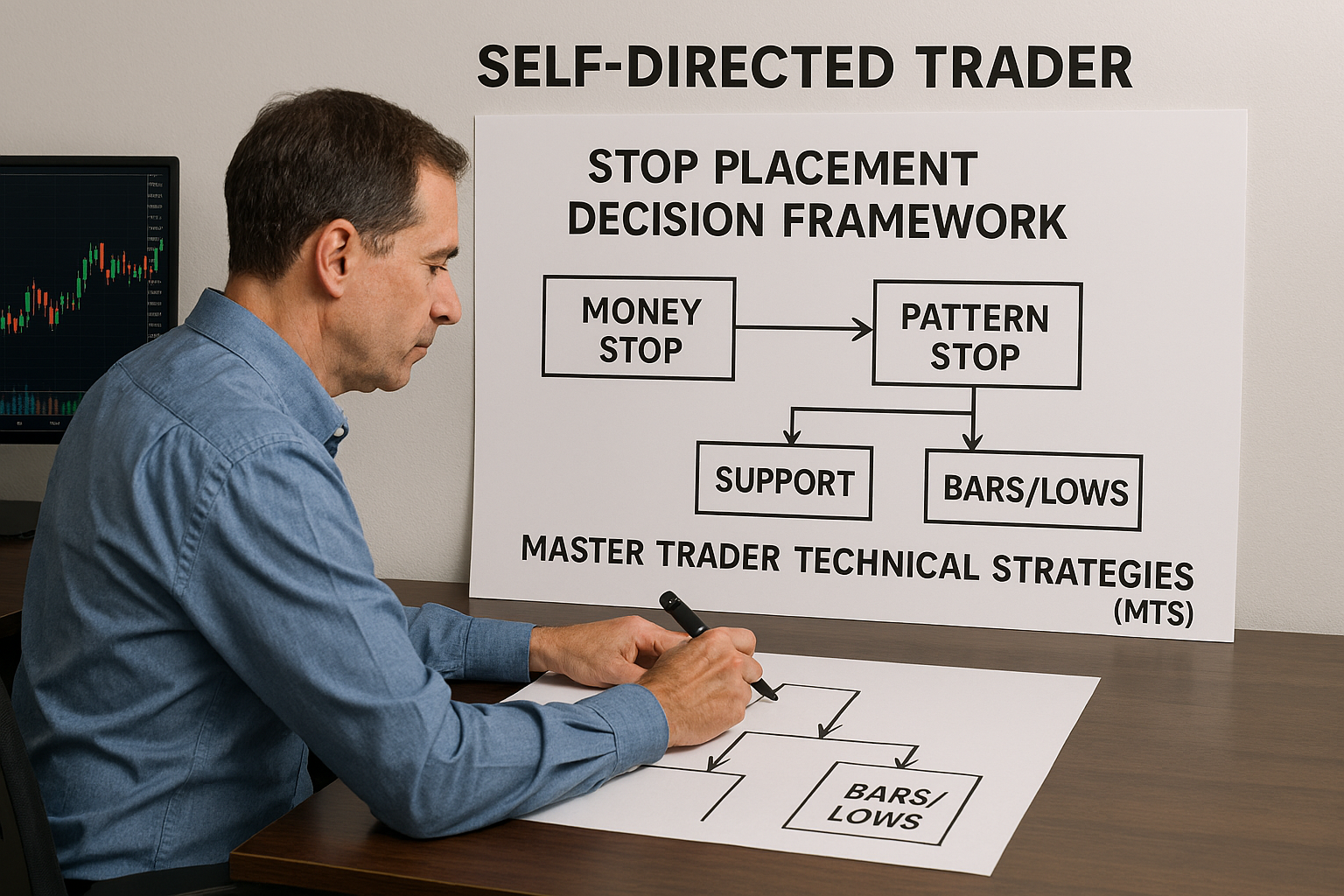
Master Trader Technical Strategies (MTS) provides a stop placement decision framework and Bar-by-Bar analysis for continuous updates.
Step 1 — Identify the Technical Line in the Sand
Start by asking:
- Does the pattern provide a clear reference point where the price should not go?
- What type of pattern communicates that price should not move beyond a certain level?
Examples students should evaluate:
- Pivot highs or lows
- Support or resistance levels
- Reversal patterns
- Trend structure (higher highs/lows or lower highs/lows)
- Wide Range Bars and their highs/lows
- Shock bars or climactic bars
The stop should be placed where the pattern thesis is proven wrong, not where the dollar loss feels comfortable.
Step 2 — Evaluate Pattern Strength (Bar-by-Bar Analysis)
Once a reference level is identified, evaluate its reliability.
Ask:
- How strong is the pattern based on bar-by-bar analysis?
- Does the reversal show authority or hesitation?
- Is there follow-through confirming the shift in supply/demand?
- Is there a Correction Bar supporting the reversal?
Strong patterns typically include:
- Wide or expansion bars
- Strong closes near highs/lows
- Multiple bars confirming the turn
- Clear rejection of a level
Weak patterns typically include:
- Overlapping bars
- Narrow ranges
- Lack of confirmation
Step 3 — Evaluate Structural Context
Before finalizing stop placement, analyze the surrounding chart structure:
Determine:
- Bars and pivots
- Support and resistance
- Trend direction
- Presence of a Void (price vacuum)
- Multiple Time Frame (MTF) alignment
Key question:
- Is there a void on the opposite side of the stop location?
Voids represent areas where price can travel quickly due to limited support or resistance. Stops placed inside a void are often vulnerable to being hit, even when the trade idea is still valid.
Step 4 — Use Multiple Time Frame Confirmation
Stops should not rely on a single time frame.
Evaluate:
- Does the stop level hold on the higher time frame?
- Does the lower time frame show confirming price behavior?
- Does the MTF trend support the trade thesis?
MTF alignment often separates professional stop placement from random placement.
Step 5 — Accept the Reality of Uncertainty
Students must internalize this principle:
- You do not know what the next bar will be.
- You do know what price should not become if your trade thesis is correct.
Stops exist to protect capital when the market proves the analysis wrong.
Step 6 — Special Warning: Reversals Into Voids
A high-risk scenario occurs when:
- Price forms a reversal pattern
- There is a void beneath that reversal
- The reversal lacks a Correction Bar
In these cases:
Stop placement becomes uncertain because the price can retrace deeply and quickly without violating the reversal pattern.
Traders should consider:
- Reducing position size
- Waiting for additional confirmation
- Accepting wider stop placement only if risk is adjusted accordingly
Step 7 — Letting Winners Run Objectively
Proper stop placement also helps manage profitable trades.
To objectively let winners run:
- Trail stops below new pivots in an uptrend (or above pivots in a downtrend)
- Use structural support/resistance rather than emotions
- Allow bar-by-bar analysis to guide stop adjustments
- Avoid tightening stops simply to protect open profit
Winners run when stops are adjusted based on the evolving structure, not out of fear of giving back gains.
The video below was a discussion on this subject in the MT Green Room.
Press the image at the lower right to open the video full-screen

If you have questions, please email me - Greg@mastertrader.com