The Power and Pitfall of Multiple Time Frame Analysis Part 1
In technical trading, multiple time frame analysis (MTFA) is a cornerstone of professional decision-making. It’s the disciplined process of using larger time frames to establish directional bias and context, and lower time frames to fine-tune entries, manage risk, and monitor trade progress.
Used properly, it helps traders align with momentum, avoid traps, and increase the probability of success. But used improperly—especially by switching time frames during a trade—it can invite confusion, hesitation, and emotional sabotage.
Let’s break it down.
The Advantages of Multiple Time Frame Analysis
1. Establishes Context for Your Setup
- The higher time frame (daily, weekly) defines the primary trend and highlights key support/resistance zones.
- This helps traders distinguish between countertrend setups and those in harmony with the broader direction.
2. Confirms Momentum and Bias
- When smaller time frames (e.g., 15-min or 5-min) align with the larger one, you gain confidence that multiple participants across time frames are active in the same direction.
3. Filters Out Noise
- Larger time frames “zoom out” the noise. A volatile 5-minute drop might just be a minor pullback on the hourly chart.
- This perspective helps avoid emotional reactions to micro-movements that aren't relevant to your trade.
4. Optimizes Entry Timing
- After defining bias and structure on the higher frame, lower time frames can be used for a precise trigger or confirmation pattern, allowing for better reward-to-risk setups.
5. Improves Trade Management
- While the higher time frame holds your target, watching how the price reacts on the lower time frame can signal early warning signs or confirmation to hold through volatility.
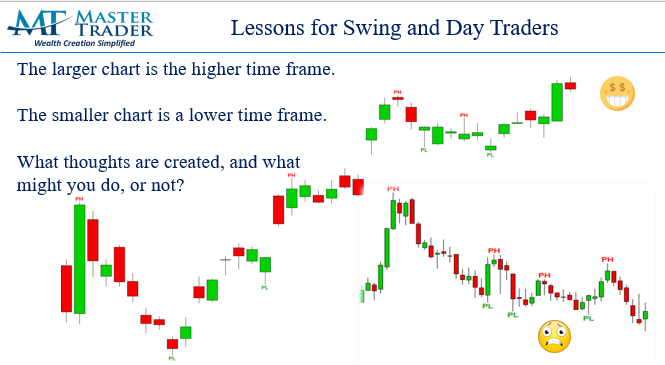
The Disadvantages of Changing Time Frames Mid-Trade
Once a trade is initiated based on a clear multi-time frame plan, changing time frames can work against you. Here’s why:
1. It Destroys Objectivity
- You may start on the 5-minute chart aligned with the daily uptrend, but when the trade pulls back, you jump to a 1-minute chart.
- Suddenly, what was a normal retracement looks like a breakdown, and fear kicks in.
- Switching time frames during a trade opens the door to bias-shifting and second-guessing.
2. It Enables Rationalization of Bad Decisions
- Traders often look at alternate time frames not for insight, but for emotional validation.
- “Maybe the 15-min is showing a reversal” becomes a justification to ignore your plan or exit early.
3. It Increases Emotional Volatility
- Watching every tick on a micro time frame magnifies every wiggle. You go from strategic to reactive.
- Even small moves against you feel like major threats, leading to premature exits or even revenge trades.
4. It Undermines Discipline
- A solid trade plan includes the time frames to be used before entry.
- Switching time frames post-entry is a slippery slope that creates inconsistency in execution, the enemy of any trading method.
5. It Confuses Trade Management Logic
- Your stop, target, and management rules are based on a specific chart.
- Changing that mid-trade redefines the structure—now you’re managing a different trade than you planned.
Bottom Line: Use Time Frames Strategically—Not Emotionally
Watch for Part II - Multi-Time Frame Confidence
Why choose Master Trade for your Financial Future?