On Memorial Day, we pause to honor and remember the military personnel who gave their lives while serving in the Armed Forces. Their sacrifice is beyond comparison. They paid the ultimate price for our country, and nothing in trading, money, or markets comes close to that loss.
That said, Memorial Day is also a day of reflection.
And for traders, reflection is something we should do far more often.
While trading losses are not life-and-death in the same way, they can still create deep emotional and financial pain. A trader who operates without a plan, without money management, and without a clear understanding of risk is operating in the unknown. That unknown creates fear, pressure, hesitation, regret, and eventually, in many cases, financial destruction.
For some traders, their financial Memorial Day is coming.
That may sound strong, but it is the truth. Not because the market is cruel, but because it is unforgiving to those who trade without a structured plan and sound money management.
In the Master Trader Green Room, we recently had an excellent open discussion with several traders about their trading styles. All of them use Master Trader Technical Strategies, but they apply them differently depending on their instruments, time frames, account sizes, personalities, and comfort levels.
That point alone is important.
There is not just one way to make money in the markets. But there is one requirement that applies to every trader: you must have a plan that includes risk control.
One trader was very good at combining multiple time frames. He might not have the ideal daily MTS pattern to go long or short, but enough daily bars may have formed to create a bias. Then, on the smaller time frame, he would look for the pattern, location, and void that supported a directional trade.
That is a professional thought process.
He was not simply reacting to movement. He was taking the bigger picture, identifying a smaller-time-frame opportunity, and then applying MTS principles to decide whether the trade had enough probability and enough room to work.
Another trader focused primarily on the QQQ, using options that expired the same day. His approach was to sell options far enough away from the current price that there was still enough premium, often seeking at least $0.50. He described it as hitting a lot of singles that can add up to a good daily profit.
That can work, but the challenge with zero-day-to-expiration options is that the premium can disappear very quickly. Because of that, he felt pressure to act early in the day, often using the five-minute chart for direction. At times, that led to entering too soon or entering at a less-than-ideal location, which then required hedging or adjusting the position.
We reviewed how better timing and better location could have produced almost twice as much premium on the same strike in one example. But that also led to the reality of trading same-day options: the best technical location and the best option premium do not always coincide.
That is where a trading plan matters.
Our personal trading plans do not always align perfectly with what the market is offering at that moment. The professional trader understands that. The amateur trader tries to force the market to provide what he wants.
This is also where trading psychology comes in. Mark Douglas taught that traders must think in probabilities and accept that anything can happen on any trade. The goal is not to know what will happen next. The goal is to consistently act on an edge, with the risk predefined before the trade is entered.
That is exactly why consistency matters.
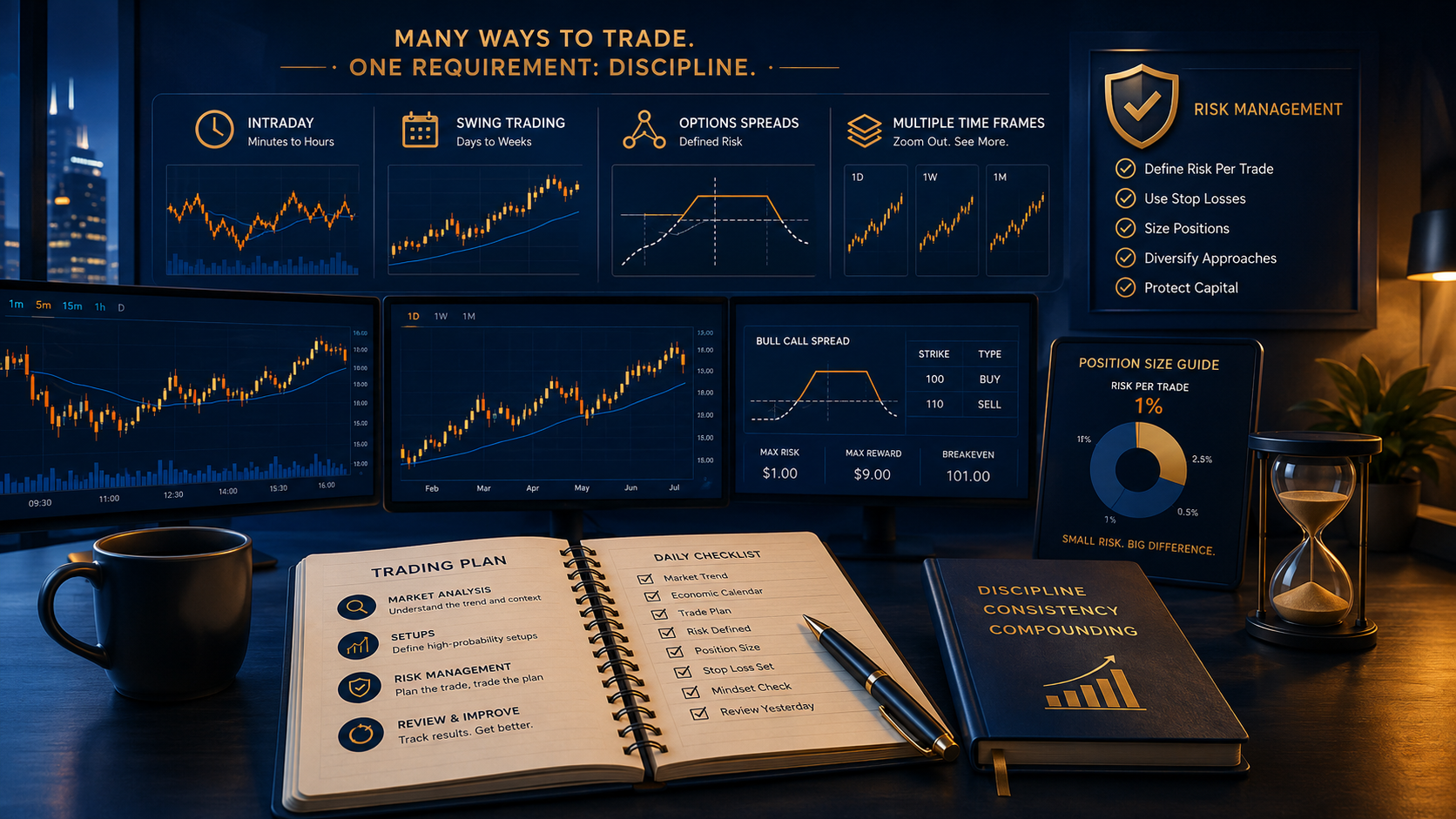
In the Green Room discussion, we all agreed that following a plan consistently is the only way to survive and make money over time as an active trader. We also discussed how money management is the most important part of that plan.
Unfortunately, many traders do not take position and money management seriously until they experience painful losses. They want the setup first, the entry second, and the money management later.
That is backward.
Van Tharp strongly emphasized position sizing and risk management, teaching that the amount you risk on each trade can have a greater impact on your long-term results than the trading system itself.
That is a critical lesson.
You can have a good method and still fail if your position size is wrong. You can have a great setup and still damage your account if the risk is too large. You can be right on the direction and still lose more than you should because you did not define the trade properly.
Another trader in the discussion primarily trades options credit spreads. A credit spread involves selling a more expensive option and buying a less expensive option against it. The credit received is the potential profit if the price does not move to the short strike by expiration. The risk is the difference between the strikes, minus the credit received.
That sounds simple, but it is not easy.
A trader selling credit spreads via MTS is looking for a price pattern indicating the market is unlikely to reach a certain level. The analysis matters. The location matters—the void matters. The broader market condition matters.
But between entry and expiration, prices can still move sharply. A trader selling spreads never wants to experience maximum loss, so the management plan becomes just as important as the entry.
There is a balance between managing based on the technical pattern and managing based on the increased possibility of a larger loss. That balance must be decided before emotion takes over.
Another trader talked about how the current market environment has made swing trading more difficult. Much of the movement has been concentrated in a smaller group of stocks, and many of those stocks are moving so rapidly that they are not forming the clean historical patterns traders are used to seeing.
That is another important point.
Market environments change.
A strategy that worked very well for a period of time can stop working for a while. This is where traders are tempted to drift from their plan. They start taking trades that are not really MTS trades. They start forcing ideas because the market is not giving them what they want. They begin to replace discipline with frustration.
Every trader has faced this at some point.

Brett Steenbarger has written extensively about trading psychology and trader development, emphasizing that successful traders adapt to changing market conditions while also developing the emotional, cognitive, and behavioral strengths needed to perform consistently.
That is exactly what professional traders must do.
Adaptation does not mean abandoning your method. It means understanding when the market is rewarding your strategy, when it is not, and what adjustments are allowed within your plan.
This brought us to one of the most important parts of the discussion: comfort level.
Comfort level means different things to different traders.
One trader may be comfortable trading leveraged ETFs intraday. Another may not be. One trader may be comfortable risking several thousand dollars on a trade. Another trader may only be comfortable risking $100 or $200.
Neither is right nor wrong.
The key is that the risk must be calculated, accepted, and appropriate for that trader’s account, experience, and emotional makeup.
A trader who sells naked options may be comfortable with the margin requirements and may have hedging strategies built into the plan. Another trader may not have the account size or the emotional tolerance for that. A trader may be willing to take assignment of an ETF if necessary, but taking assignment of 200 or 300 shares of the QQQ is a very different financial reality than simply saying, “I’ll manage it.”
The same applies to credit spreads.
Some traders are very comfortable trading them. Others are not. Zero-DTE spreads can be easier to manage in one sense because there is no overnight risk, but they move fast. Holding spreads overnight or for several days introduces event risk, gap risk, and the possibility of waking up to a position that has changed dramatically.
Not every trader can sleep well with that risk.
That does not make one trader better than another. It simply means every trader must know themselves.
This is why professional trading is not about copying someone else’s trades. It is about developing a method, a plan, and a risk structure that fits you.
There are many ways to make money in the markets. But a true edge is not just a setup. An edge is a repeatable process that includes setup, entry, stop, target, management, position size, and the emotional ability to follow it.
Without that, the trader is not building a business. He is gambling with a chart in front of him.

The discussions we have in the Master Trader Green Room have been a terrific learning experience for everyone involved. I appreciate traders' willingness to share what they are doing, what is working, what is difficult, and how they are applying MTS in different ways.
That kind of open discussion is valuable because it shows the real world of trading. Not theory. Not hype. Not someone showing only perfect hindsight examples.
Real trading.
Different instruments. Different time frames. Different personalities. Different risks. Different plans.
But the same core truth applies to all of them.
If your trading does not include a position and money management plan, your life as a trader will be short. If you start with a large account, the destruction process may take longer. But without discipline, risk control, and a professional plan, the ending is usually the same.
On Memorial Day, we remember those who gave everything for our country.
As traders, we can also use this day to remember something far smaller, but still important in our own lives: do not sacrifice your financial future because you refused to build and follow a plan.
The market will always be there.
The question is whether you will be.
Join us in the Green Room and learn how experienced traders approach the markets with discipline, structure, and confidence. Get two months for the price of one
If you have found this post helpful, Share it Forward with other Traders
All the best
Greg Capra