Don’t Trust Your Mind When Trading
Every trader reaches a point where they realize something uncomfortable:
The greatest threat to a well-designed trading plan isn’t the market — it’s the mind executing it.
You’ve done the work.
You’ve studied charts, tested patterns, and built a methodology grounded in logic rather than opinion. Yet in the moment of execution, thoughts appear that tempt you to override everything you know to be true.
This is not a lack of knowledge.
It’s the nature of decision-making under uncertainty.
The Foundation You’ve Already Built
If you’ve invested the time to develop a professional approach, you likely understand the core elements that create a trading edge:
- A defined trading plan built from an extensive chart review
- A deep understanding of technical concepts and how they combine into strategies
- Position sizing rules tied directly to acceptable risk
- Multi-timeframe alignment and trading within a tradable void
- Bar-by-bar analysis to guide execution and management
Within Master Trader Technical Strategies (MTS), these elements form the structure that turns trading from opinion into process.
So here’s the real question:
If the plan is sound, why would you trust your mind in the moment to override it?
The Mind’s Constant Temptation
Even with a tested plan, your thoughts will try to negotiate with you during a trade.
You may hear:
- “Maybe I should take profits early.”
- “This doesn’t feel right — maybe I shouldn’t enter.”
- “I’ll give it a little more room; it might come back.”
These thoughts feel logical because they are tied to emotion — fear of loss, fear of missing out, or the desire to be right.
The problem is not that these thoughts exist.
The problem is believing they are reliable.
The Reinforcement Trap
Our minds are excellent at rewriting history to justify behavior.
- If you deviate from your plan and the trade still reaches the target, you feel regret.
- If you exit early and the price later fails, you feel validated.
- If you skip a setup and it loses, you feel “smart.”
This inconsistent feedback loop reinforces randomness in behavior, even when your strategy itself has a statistical edge.
And that’s the key:
Your edge plays out over a series of trades, not in any single outcome.
The Stop Loss Battle
Few moments test discipline more than when the price approaches your stop.
Before entering, you clearly defined:
- The level that invalidates the setup
- The dollar risk is aligned with your money management rules
Yet in real time, the mind begins negotiating:
“Maybe it just needs a little more room.”
When traders move stops, they aren’t adjusting strategy — they’re reacting emotionally.
This is where small, planned losses often turn into large, unplanned ones.
The Other Side: Not Taking the Trade
Psychology doesn’t only show up as poor exits.
It also shows up as hesitation.
You see the setup.
Your analysis confirms it.
Your plan says act.
But your will says no.
If the trade works, frustration follows.
If it fails, avoidance feels justified.
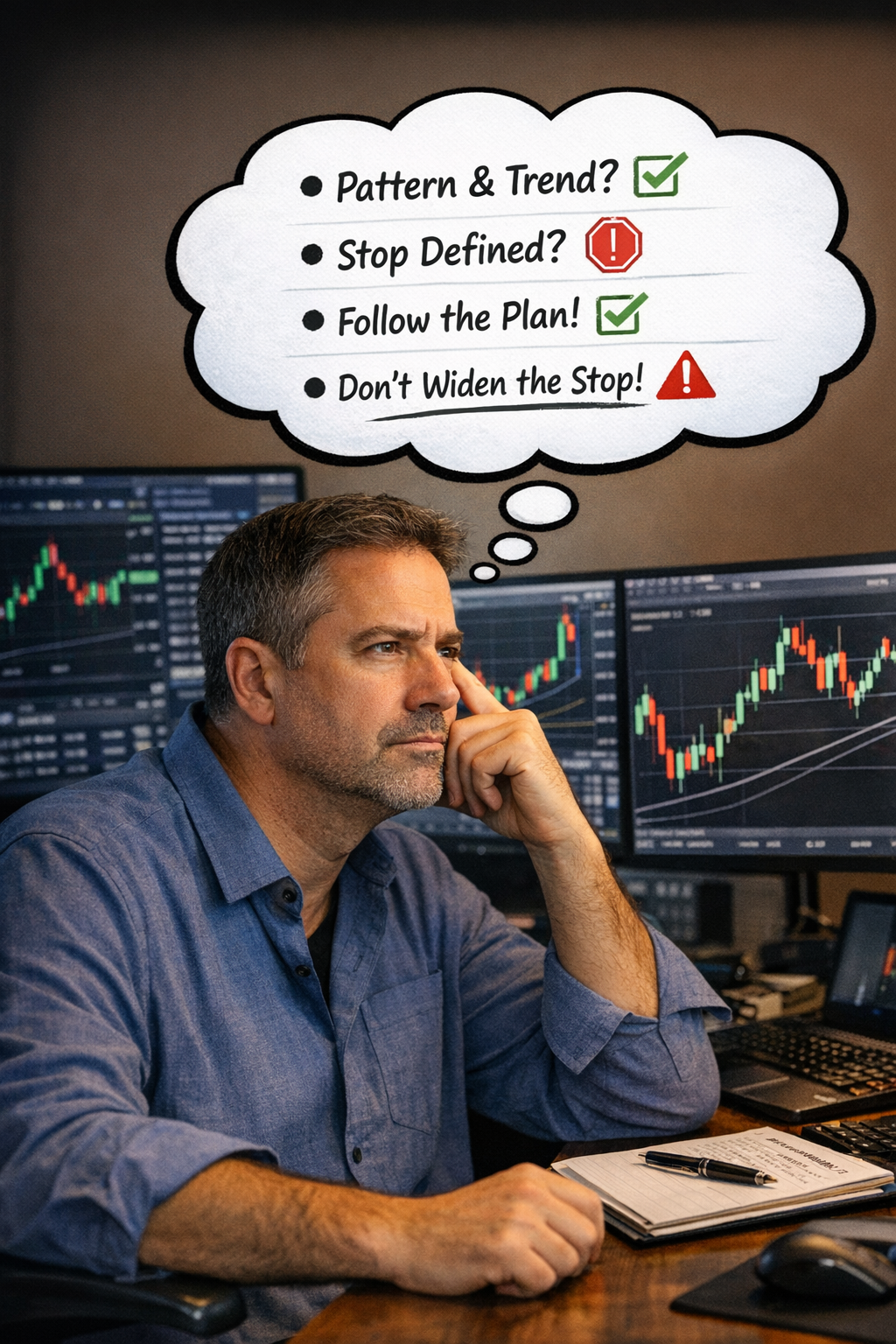
Both outcomes reinforce the illusion that intuition is more reliable than process — when in reality, it’s simply randomness disguised as insight.
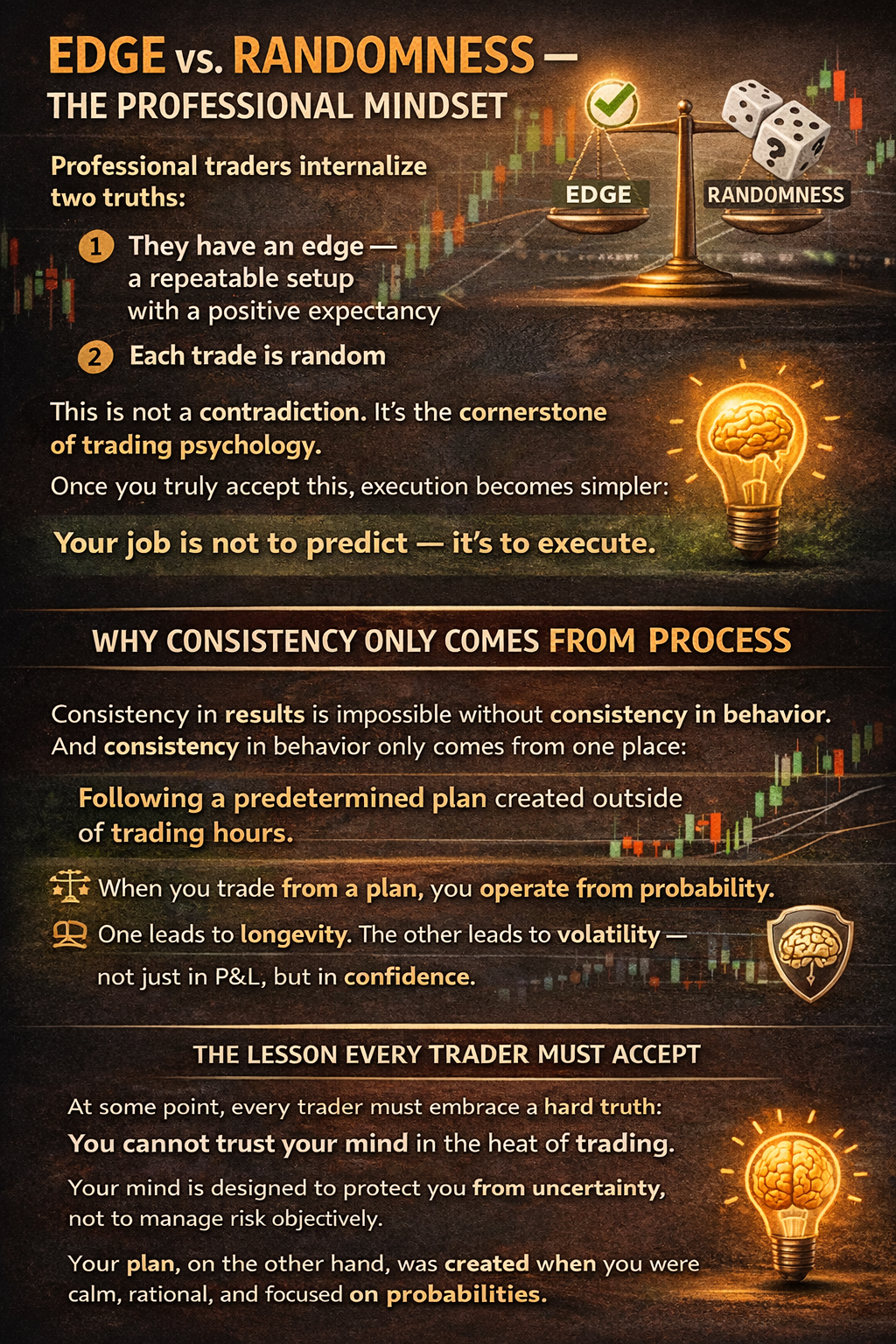
Edge vs. Randomness — The Professional Mindset
Professional traders internalize two truths:
They have an edge — a repeatable setup with a positive expectancy
Each trade is random
This is not a contradiction.
It’s the cornerstone of trading psychology.
Once you truly accept this, execution becomes simpler:
Your job is not to predict — it’s to execute.
Why Consistency Only Comes From Following the Process
Consistency in results is impossible without consistency in behavior.
And consistency in behavior only comes from one place:
Following a predetermined plan created outside of trading hours.
When you trade from a plan, you operate from probability.
When you trade from thoughts, you operate from emotion.
One leads to longevity.
The other leads to volatility — not just in P&L, but in confidence.
The Lesson Every Trader Must Accept
At some point, every trader must embrace a hard truth:
You cannot trust your mind in the heat of trading.
Your mind is designed to protect you from uncertainty, not to manage risk objectively.
Your plan, on the other hand, was created when you were calm, rational, and focused on probabilities.
That is the version of you that deserves control.
Master Trader Thought
The goal is not to eliminate thoughts — that’s impossible.
The goal is to recognize them as noise and return to the process.
Because in trading, discipline isn’t about being perfect.
It’s about being consistent enough for your edge to play out over time.
And that only happens when you trust your plan more than your impulses.
A Complete Trading Education Requires More Than Technical Analysis
Technical strategies identify opportunities. Management strategies protect capital. Psychological training ensures execution consistency.
All three components must work together to achieve long-term trading mastery.
Many traders focus heavily on chart patterns and indicators while neglecting emotional discipline and risk control. This imbalance is one of the primary reasons traders struggle to produce consistent results.
A complete trading education integrates:
Multi-time-frame technical analysis
Structured position and money management
Psychological performance development
When these elements align, traders can execute their plan regardless of market noise or emotional pressure.
If you have found this post helpful, Share it Forward with other Traders
All the best
Greg Capra