Let's create the checklist and then review a chart with it. We will put a lot of thought into it, which, in time becomes an automated part of your thought process.
Breakout trading is one of the most widely used strategies in the markets.
Stocks, ETFs, futures, currencies—it doesn’t matter. Traders are constantly looking for prices to break above resistance or below support and “go.”
The problem is that most breakouts don’t go very far… and many fail.
That’s not because breakouts don’t work.
More...
It’s because most traders don’t understand which breakouts are worth trading—and which ones to ignore.
A checklist solves that problem.
Not a random list of ideas… but a structured way to evaluate trend, structure, and probability before you put capital at risk.
The Foundation of a Quality Breakout
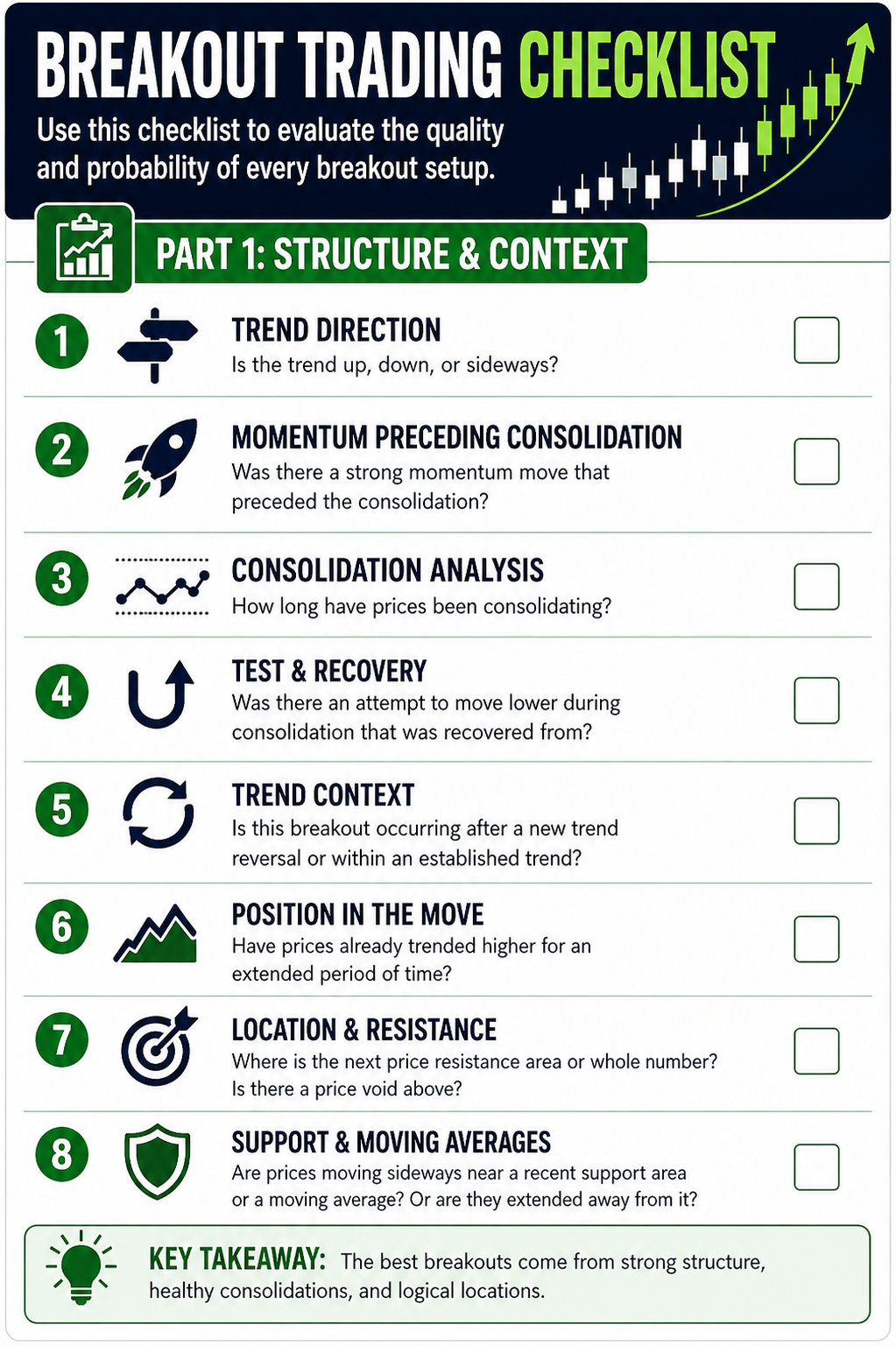
Before you ever think about entry, you need context.
Ask yourself:
- Is the trend up, down, or sideways?
- Was there a strong momentum move prior to the consolidation?
- How long has price been consolidating?
- Was there a failed move lower that was bought?
- Is this breakout coming after a reversal or within an established trend?
- Have prices already trended for an extended period of time?
Breakouts don’t happen in isolation.
They are the result of order flow building within a structure.
If that structure isn’t right, the breakout is far more likely to fail.
Location Matters More Than the Pattern
Two identical breakout patterns can have completely different outcomes based on where they occur.
Add these questions to your process:
- Where is the next resistance level or whole number?
- Is there a price void (little resistance to the left)?
- Are prices consolidating near support or a moving average?
- Or are they already extended away from it?
A breakout that occurs near support, with room to move, has a very different probability than one that is extended into resistance.
The Trigger Bar: Where Most Traders Get It Wrong
This is where many traders lose consistency.
They see price tick above resistance and jump in—without evaluating the quality of the move.
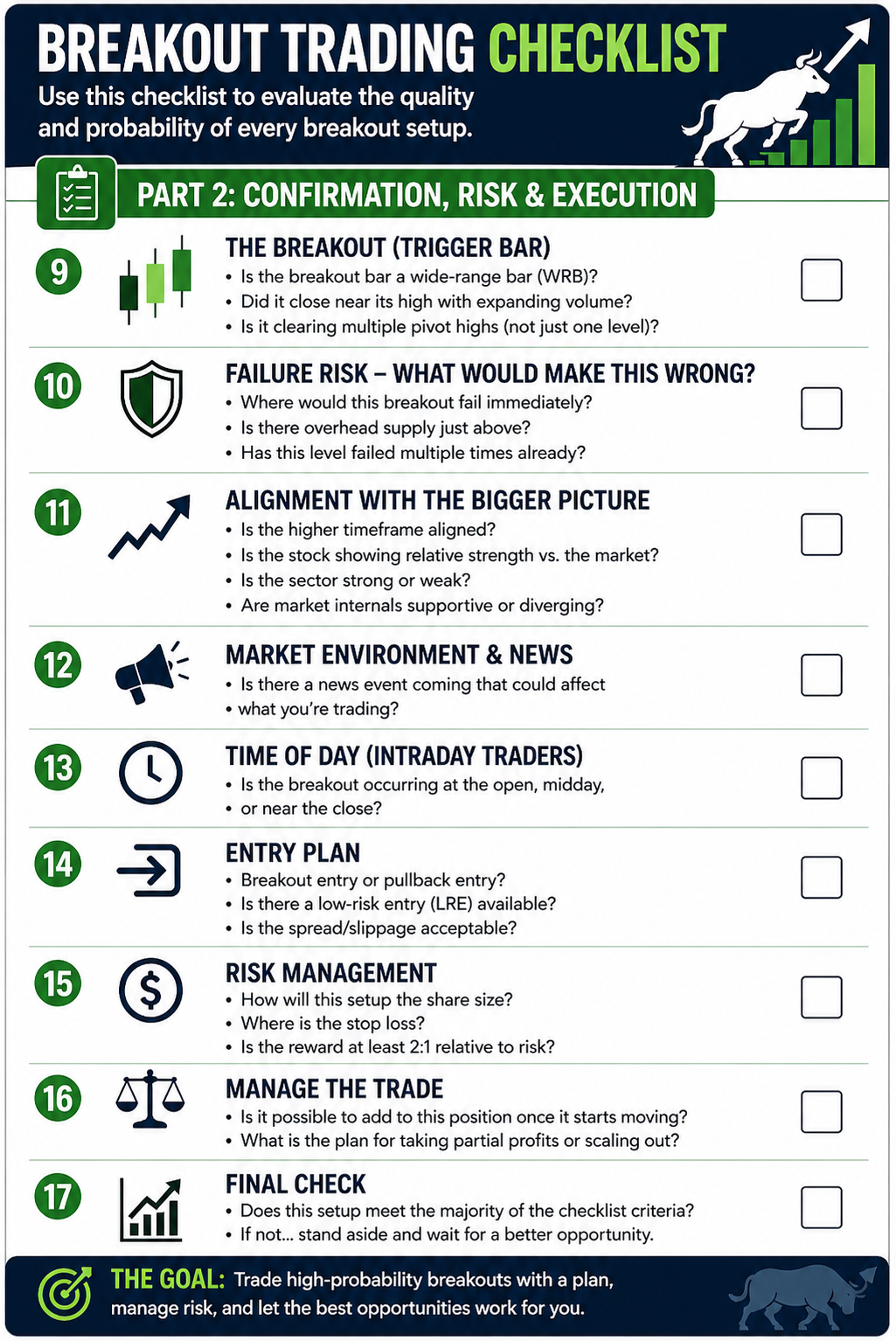
Instead, focus on the breakout bar itself:
- Is it a wide-range bar (WRB)?
- Did it close near its high?
- Is there an increase in volume?
- Is it clearing multiple pivot highs—not just a single level?
Strong breakouts show commitment.
Weak breakouts drift… and often reverse.
Define the Risk Before the Trade
A high-quality setup isn’t just about upside—it’s about knowing when you’re wrong.
Ask:
- Where would this breakout fail quickly?
- Is there overhead supply just above?
- Has this level already failed multiple times?
If you can’t clearly define where the trade is invalid…
you don’t have a trade—you have an opinion.
Part 2 of the list is below
Understand Where You Are in the Move
This is one of the most overlooked pieces of analysis.
Every breakout falls into one of three categories:
- Early-stage (highest probability continuation)
- Mid-trend (still tradable, more selective)
- Late-stage / extended (higher failure risk)
The further along the trend is, the more cautious you need to be—especially with breakout entries.
Align with the Bigger Picture
Breakouts don’t happen in a vacuum.
You want alignment across multiple factors:
- Is the higher timeframe in agreement?
- Is the stock showing relative strength vs. the market?
- Is the sector leading or lagging?
- Are market internals supportive—or diverging?
This is where traders gain a real edge.
When technical structure aligns with broader market conditions,
the probability of follow-through increases significantly.
Entry, Risk, and Trade Management
A checklist isn’t complete without execution planning.
Before entering, define:
- Breakout entry vs. pullback entry
- Share size based on risk
- Stop-loss placement
- Reward-to-risk (is it at least 2:1?)
- Potential to add to the position if it works
The goal isn’t just to find trades.
It’s to manage them with consistency.
You may find this hard to believe, but most new to trading - if they survive, consider position and money management after trading for a while.
Of course, why many blow up an account.
Risk management and when to add to a position is one of the keys to success.
Creating Your Trading Strategies
A Real-Time Example: S&P 500
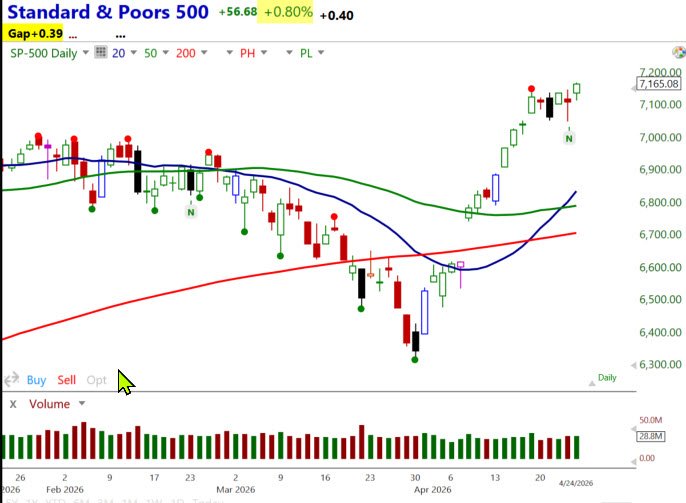
Looking at the current S&P 500 structure:
- The market formed a V-bottom reversal
- Followed by a strong momentum move higher
- Then transitioned into a tight consolidation near the highs
- There is a "Correction Bar" within the base
On the surface, this looks like a bullish breakout setup.
And it is.
But the checklist adds an important layer of insight:
- Price is already extended after a vertical move
- The breakout is not early-stage—it’s later in the trend
- While the trend is still up, the risk of reduced follow-through increases
That doesn’t mean you can’t trade it.
It means:
- Chasing the breakout is lower quality
- Waiting for a pullback may offer a better opportunity
That’s the difference between reacting to patterns…
and making informed trading decisions.
S&P 500 and Internal Market Gauges
Why Most Traders Struggle with Breakouts
It’s not a lack of setups.
It’s a lack of structure.
Most traders:
- Focus only on the breakout line
- Ignore trend and location
- Enter without a defined risk plan
A checklist changes that.
It forces you to slow down, think objectively, and trade with a plan.
Turning the Checklist into a Skill
Reading a checklist is one thing.
Applying it in real time—bar by bar—is where consistency comes from.
That’s why we put so much emphasis on understanding how to read price as it unfolds, not just recognizing patterns after the fact.
If you want to take this further, our Mastering Candlesticks – Bar-by-Bar Analysis training walks you through exactly how to interpret each bar, each consolidation, and each breakout as it’s happening.
Because once you understand what the bars are telling you,
you stop guessing—and start making decisions with confidence.
MTS Thoughts
Breakouts are powerful—but only when traded in the right context.
A structured checklist helps you:
- Filter out low-quality setups
- Improve timing
- Control risk
- Stay consistent
And in trading, consistency—not excitement—is what leads to long-term success.
When you learn how these concepts fit together, as I have done in the Bar-By-Bar Course, your trades make far more sense — and your trading decisions become clearer, more confident, and more consistent.
If you have found this post helpful, Share it Forward with other Traders
All the best
Greg Capra