
Position Size Controls Planned Trade Risk - Day Trader Pattern PDT Rule Tip Below
Yes. A higher-priced stock can be traded responsibly when you have sufficient buying power and determine the risk before entering. The Master Trader Technical Strategies (MTS) process begins with a quality technical setup and a chart-based stop. Your account size and maximum risk then determine the number of shares—not the other way around.
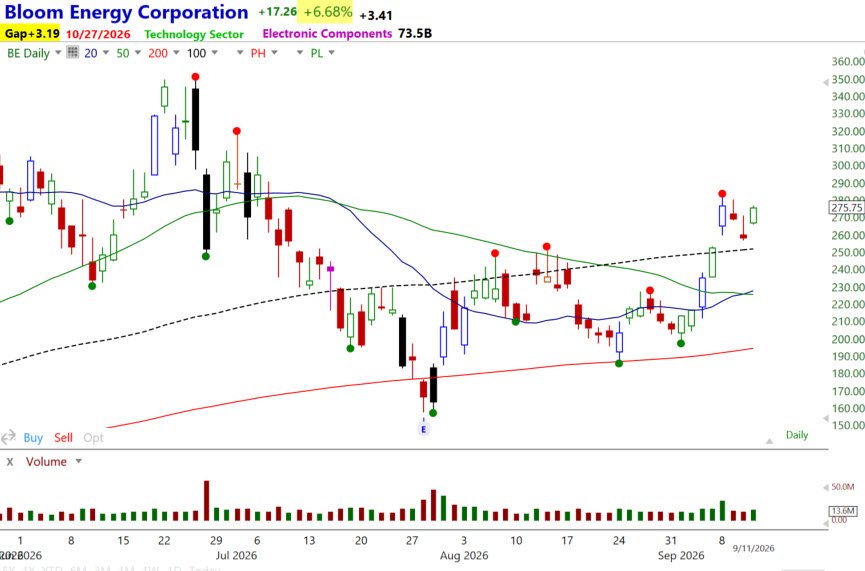
Let’s review the process with the stock Bloom Energy (BE)
The MTS Decision Process
Reading the BE Setup Through MTS
MTS confirmation checklist. Before entry, also review the weekly chart, nearby overhead resistance, the relevant sector and broader market, liquidity, and scheduled earnings or company news. One daily chart should not be used in isolation.
Invest and Trade Like a Professional - Master Trader Education - The Labor50 Coupon Code is Live Through Monday - Individual Course and Annual Memberships.
Position Size Calculation
Assume a $30,000 account and a maximum planned risk of 1%, or $300, for this example. The percentage is illustrative; each trader must choose a risk level appropriate for the account, experience, and strategy.
Item | Amount | Calculation or meaning |
Account size | $30,000 | Example account |
Maximum risk | $300 | 1% of the example account |
Entry | $283.85 | Slightly above the $283.83 trigger |
Stop | $256.98 | Slightly below the $257.01 turn low |
Risk per share | $26.87 | $283.85 − $256.98 |
Maximum whole shares | 11 | Floor of $300 ÷ $26.87 |
Planned risk at 11 shares | $295.57 | 11 × $26.87 |
Capital required at entry | $3,122.35 | 11 × $283.85, before costs |
If you prefer an even 10-share position, the planned risk is $268.70—not $300—and the capital required is $2,838.50. The stock’s price determines the capital needed to buy the shares; the distance from entry to stop determines the planned risk.
Managing the Position With MTS
The central lesson. You do not control risk by avoiding higher-priced stocks. You control it by selecting a technically valid entry and stop, calculating the correct share size, and managing the trade consistently.
Build the Complete Skill Set
Master Trader Technical Strategies courses teach you how to evaluate price action objectively through trends, pivots, support and resistance, multiple time frames, wide-range bars, moving averages, and bar-by-bar analysis.
The Advanced Position and Money Management course connects that technical analysis to account risk, position sizing, trade management, and consistent decision-making.
Together, these courses help traders move beyond finding a chart pattern. They teach the complete thought process—from recognizing the opportunity to controlling risk and managing the position.
Explore Master Trader courses and education: mastertrader.com/trading-education/
Buying Power Matters Too - Pattern Day Trader Rule
The $3,122.35 is the position value, not necessarily the amount of cash required. Under FINRA’s new intraday margin framework, the $25,000 Pattern Day Trader minimum is being eliminated.
Once implemented by the broker, eligible stocks may receive approximately 4:1 intraday buying power, so this position could use about $780.59 of margin capacity. Brokers can impose higher requirements and have until October 20, 2027, to adopt the new rules. FINRA
If held overnight, the position generally requires 50% margin, or approximately $1,561.18. Leverage reduces the buying power used, but it does not reduce trade risk: 11 shares still have approximately $295.57 at risk to the stop. Additional trades should be taken only when the combined open risk remains within the trader’s predetermined account-risk limit.
If you have found this post helpful, Share it Forward with other Traders. All the best Greg Capra