Master Trader Method = Multi-Time Frame Confidence
We teach traders how to align bias, entries, and management across time frames—objectively, consistently, profitably.
How Traders Can Build Discipline to Follow Their Time Frame Plan
Multiple time frame analysis is a professional strategy, but its power lies in consistency and discipline, not just technical knowledge.
Here’s how to develop the mental and practical edge to follow the plan, avoid emotional detours, and respect the time frame that defines the trade.
1. Start with a Written Trading Plan
Discipline begins before the trade.
- Write down the bias time frame, the entry/trigger time frame, and the management/stop logic time frame.
- Define:
- Directional bias
- Setup criteria
- Stop and target location
- Time frame you’ll manage the trade from.
- If it’s not written down, it’s negotiable—and negotiable leads to emotional.
2. Commit to One Set of Charts Per Trade
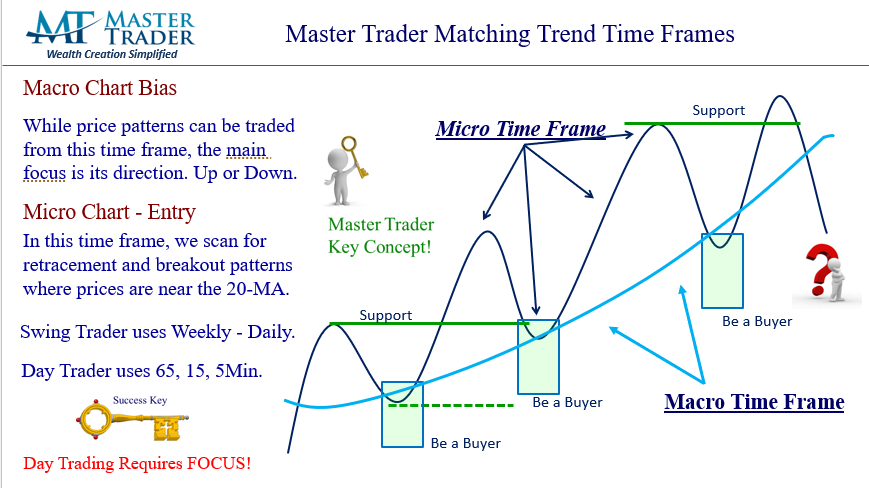
Each trade is based on a specific combination of time frames. Lock in:
- A bias chart (e.g., daily)
- A trigger chart (e.g., 15-min) – Your choice. None are perfect.
- A management chart (often the same as entry or 1-level below)
Once the trade is placed, don’t rotate between charts trying to validate fear or hope. This is chart-hopping, and it leads to confusion and undisciplined decisions.
3. Use a Checklist for Execution
A checklist is a tool for removing emotion from execution. Include:
- Are all time frames aligned?
- Is this a confirmed setup?
- Is my entry chart defined?
- What chart will I manage this from?
Review it every trade. Eventually, it becomes a habit—but early on, it's your anchor.
4. Respect Your Management Time Frame
- If you entered on the 15-min, manage on the 15-min.
- If you switch to the 1-min to avoid pain, you're trading a different plan.
5. Journal the Wins and Losses Based on Time Frame Integrity
- Track whether your trades respected the original time frame or not.
- Many traders lose, not because their idea was wrong, but because they abandoned their time frame midway.
6. Use Alarms, Not Constant Watching
Over-watching a trade on smaller time frames invites anxiety.
- Set alerts at key levels and let the trade work.
- This protects your discipline and prevents micromanaging.
7. Remember: Consistency > Accuracy
You're not going to be right on every trade. That’s fine.
What matters is that your strategy is executed consistently, so your results can be trusted and refined.
Discipline is a Muscle, Not a Switch
Like a well-built trading method, discipline is practiced, not gifted.
By honoring the time frame logic behind your trades, you become a strategist, not just a pattern chaser.
Choose the time frame. Stick to the plan. Let the probabilities work.
Respect the structure you used to define the trade. That’s the only way your results will have "integrity" —and be repeatable.
Why choose Master Trade for your Financial Future?