In Part 1, we covered Stage One: Ambivalence, and Stage Two: Uptrend and Greed.
Let's cover Stage Three: Indecision and Stage Four: Downtrend and Fear.
The four stages offer specific ways to treat a stock in each stage, and every Advisory Swing, Options, Weekly Options, or ETF letter trade will be one of the four stages.
Stage Three: Indecision
In Stage Three, bulls and bears battle for control. Prices go sideways in a wide, erratic range. Unknowing traders try to play breakouts and breakdowns during this period and often lose money.
If the pattern stabilizes and resumes its upward trajectory, this is simply a pause in Stage Two.
However, if the balance of power shifts, one of the breakdowns will not find buyers, and the price will drop.
Bulls realize they are in losing positions and begin to exit, triggering the start of Stage Four.
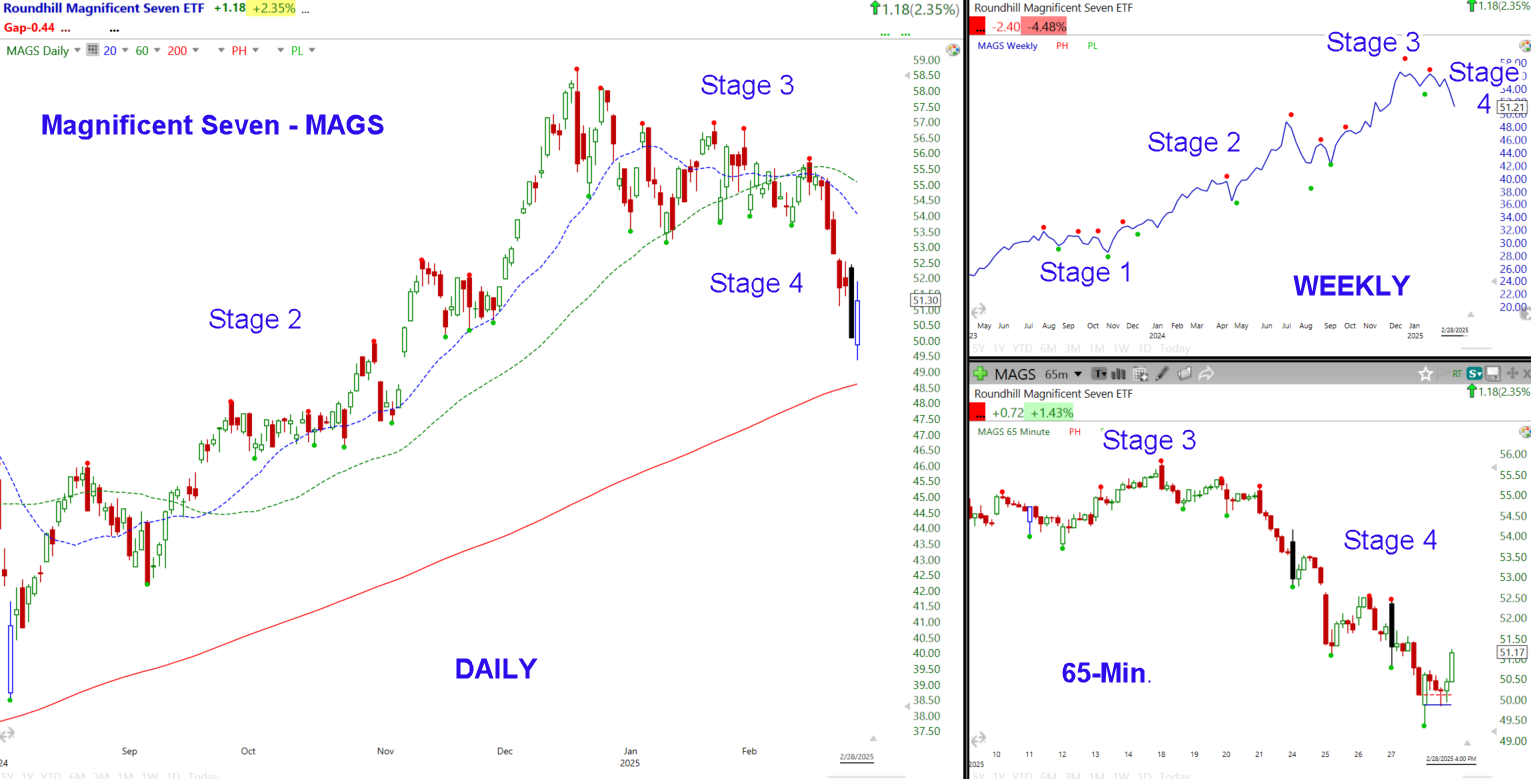
The below chart of MAGS has moved to Stage 4 in all three of the time frames shown.
When the daily and weekly were both in a Stage 2 uptrend, buy pullbacks and breakouts.
Stage 3 marked a period of uncertainty when Master Traders waited for a clear direction.
When MAGS broke lower to Stage 4, the Master Trader ETF trader shorted.
The Master Trader Advisory Swing and Options Trader bought put options.
Both letters hold open positions.
Stage Four: Downtrend and Fear
As fear accelerates, selling increases, driving prices lower. Even those who vowed never to sell capitulate. All potential sellers exit the market at some point, and the stock stops falling.
There are no buyers, as the pain has kept old bulls and new buyers away. The stock drifts sideways in ambivalence, marking a return to Stage One.
The Cycle Repeats
This four-stage cycle plays out across all time frames—from intraday charts to weekly and monthly charts. Identifying these stages does something crucial: it keeps us objective. Stocks or markets will always fall into these stages in the same order.
Trading Strategies for Each Stage
For every stage, there is a correct way to play the stock. Each stage dictates the direction and strategies that will maximize the movement:
- Stage One: Avoid trading or wait for signs of accumulation.
- Stage Two: Buy during the early uptrend and hold through the sweet spot.
- Stage Three: Avoid speculative breakouts or breakdowns.
- Stage Four: Short sell or avoid buying until a base forms.
Controlling Subjectivity
While hindsight makes identifying stages easy, real-time analysis can be challenging.
Subjectivity can never be totally eliminated from technical analysis but can be minimized.
If you are unsure about a stock’s stage, you have the right to pass on the trade and wait for a clearer opportunity.
Key Takeaways
Winning traders and investors learn to identify which cycle a stock or market has entered and trade accordingly. Buying in the early stages of Stage Two and selling before Stage Three are key to success.
Losing traders, by contrast, react emotionally or rely on subjective indicators. These individuals inevitably buy late in Stage Two and sell near the end of Stage Four.
The Second Truth: Price Directions
A stock or market can do one of three things:
- Go up: Higher highs and higher lows (Stage Two).
- Go down: Lower highs and lower lows (Stage Four).
- Go sideways: Either in a stable range (Stage One) or a volatile range (Stage Three).
Knowing the current stage and trend allows traders to make high-probability trades based on price movements. This structured, objective approach removes guesswork and emotion, paving the way for consistent market success.
Join Master Trader Weekly Advantage Today! 🔥
Why choose Master Trade for your Financial Future?