When we say “buy a ½ lot,” we’re not being cautious for the sake of caution—and we’re not questioning the technical setup.
A ½ lot simply means half the normal share size you would take for a full-risk position, based on your predefined dollar risk.
At Master Trader, every position size in the tracking sheet in the Member's Area and is calculated based on an assumed standard $300 maximum risk per trade. That risk is defined before the trade is placed—based on entry, stop location, and share size.
So why would we ever suggest half-size if the setup looks good?
Even when a ½ lot is suggested, the technical direction remains valid. The pattern still favors the trade. The difference is context and we look to add to the position when we get more information.
Most often, we recommend a reduced size in bottoming patterns or because there is a Void—a meaningful distance between price and the next clearly defined support level.
This is especially common with continuation patterns.
Continuation patterns typically form after:
- A strong momentum move
- A brief consolidation or shallow pullback
- An attempt to resume the trend
Historically, these patterns work often—but not always.
And that “not always” is exactly where money management matters.
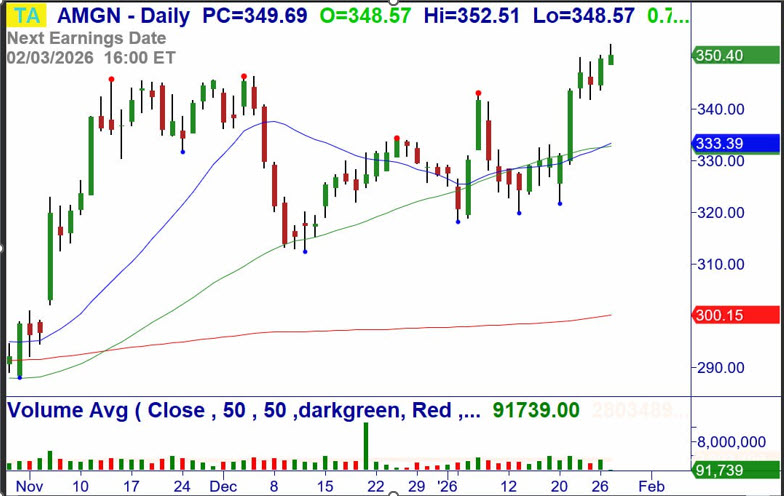
The AMGN Example: A Great Setup from the Advisory Swing and Options Letter That Didn’t Work
Let’s look at Amgen (AMGN), a trade posted in the chat:
AMGN – buy ½ lot high, stop Friday low
Later updated as:
- Entry: $352.53
- Pattern: Continuation breakout
- Trend: Bullish weekly and monthly
- Stop: $341.68
The stop was placed just below the low of the red-bodied candle—textbook technical placement.
Everything about the setup checked out:
- Trend alignment across multiple timeframes
- Strong sector participation
- Clean continuation structure
And yet… the trade was stopped out.
“What Went Wrong?”
Nothing went wrong.
This is one of the hardest lessons newer traders struggle with.
A good setup does not guarantee a winning trade.
Technically, AMGN:
- Remained in an uptrend
- Did not violate Major Support (MS)
- Held rising moving averages
So why take the stop?
Because price did what price sometimes does—it tested lower before resolving direction. And in this case, it dipped just enough to trigger the stop.
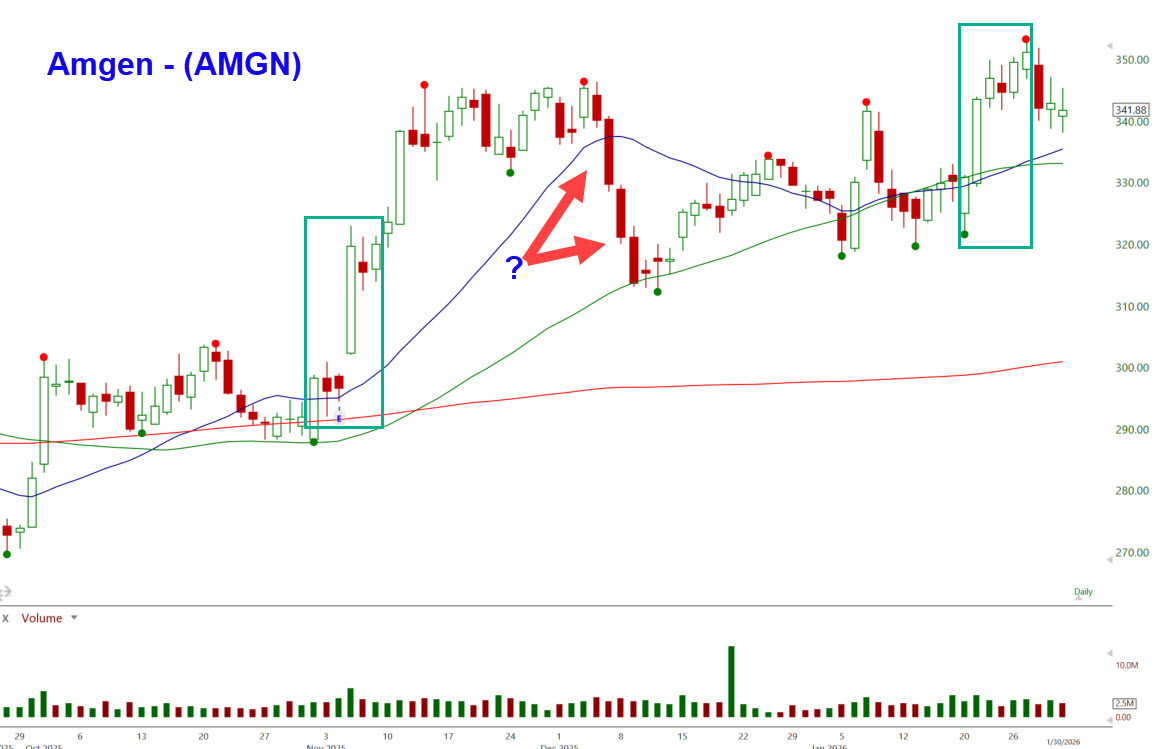
Look at the earlier green box on the chart:
- Bullish wide-range bullish bar (+WRB)
- Sideways consolidation
- Successful continuation
That pattern worked beautifully.
Later, a similar—but not identical—pattern failed first, then recovered.
This is where traders get trapped.
The Psychological Trap
After seeing price recover in the past, traders start believing:
“If I just give it more room, it’ll come back.”
Sometimes it does.
Sometimes it doesn’t.
The danger isn’t the one trade—it’s what happens when stops stop being honored.
Eventually:
- Losses grow larger than planned
- Confidence erodes
- Fear replaces discipline
- Traders hesitate on valid setups
- Or worse, they stop trading altogether
This spiral is common—and completely avoidable.
Why ½ Lot Matters
In the AMGN trade:
- Full risk would have been ~$300
- Half size reduced the loss to ~$150
That’s the difference between:
- A routine business expense, and
- An emotional setback
Because the risk was controlled, we moved on—clear-headed, disciplined, and ready for the next opportunity.
AMGN may set up again in the coming days.
If it does, some will ask:
“Why did we get out if it’s going higher now?”
That’s hindsight talking.
It could just as easily fail again and break major support.
No one knows in advance.
How Professionals Think About Risk
Professional traders don’t try to eliminate uncertainty.
They accept it.
What allows them to do that is trust in their money management.
- They size positions correctly
- They honor stops consistently
- They accept small losses without emotional damage
- They stay mentally available for the next trade
That’s the real edge.
Not a prediction.
Not indicators.
Risk control.
And sometimes, that means buying ½ a lot.
If you've found this helpful, share it with others!
All the best,
Greg Capra