
The stock market goes through cycles of boom and bust. You would think there would be stability after decades of trying to get it right.
Two primary reasons the markets will always have cycles of boom and bust are political manipulation of monetary liquidity and fear and greed.
Monetary liquidity is controlled by the Federal Reserve Board and is supposed to be independent of political manipulation. The evidence is clear that it is not true.
Every member of the Federal Reserve Board has studied the historical changes of adding and withdrawing liquidity and its effect on the economy and stock market.
Having devoted their lives to becoming experts, how do they get it wrong every time? The only answer is political manipulation.
How Does the Stock Market React to Changes in Liquidity?
The reference of the stock market is a general reference to individuals. Those individuals are money managers, traders, investors, everyone.
The fundamentals of an individual company will affect its performance. However, adding liquidity - a rising tide - will lift all boats from a broad point of view.
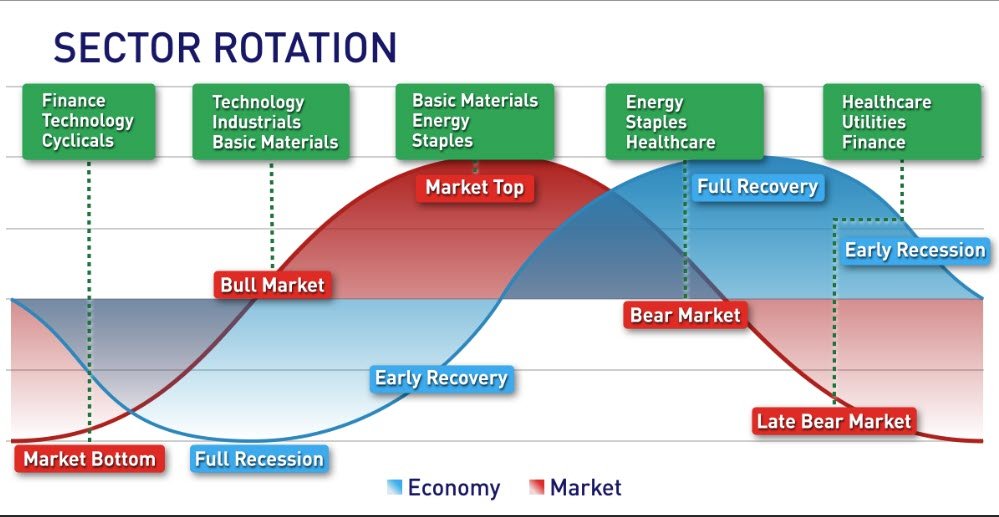
The chart below shows the cycle of sectors based on the cycle of the economy.
During a period of liquidly being added, a bull market, most sectors are rising.
The greater the amount of money pumped in, the bigger the bull.
Most sectors fall when liquidity is removed, a bear market.
What Happened in the Stock Market Cycle and Where is it Going?
When the pandemic came, and the world leader believed the best action was to close everything (the world), the implications were there would be no business and no profits, and of course, the stock market crashed.
When the stock market crashes, the Fed reacts by adding liquidity.
This time, the political manipulation was beyond anyone’s belief.
The government created so much liquidity that a significant amount of money has never been spent.
When politicians cannot find a way to spend every dime, even they know they went to far. Now we are paying the price.
The stock market reacted as it always does; it went up.
It was so much liquidity that it added “rocket fuel” that drove the markets straight up – the Boom.
Now we have the largest inflation in 40 years and a bust cycle.
The Nasdaq 100 is down over 30% and can go lower. The last bust cycle top in 2000 was the mother of them, where the Nasdaq dropped an amazing 90%!
Today is not the same as in 2000, but there seems to be more downside.
However, the markets are close to a counter-trend rally in the short term.
The Stock Market has a Repeating Cycle of Boom and Bust and Boom.
At this time, the stock market is nearing the end of a Bust and close to a Boom.
Here is the cycle of Booms and Busts shown in percentage gains and losses since 2005.

Stock Market Cycles of Percentage Gains and Losses.
You can see from the above, the next Boom cycle starts next year.
The image above shows yearly percentage gains and losses but does not show the timing of the turn.
That timing cycle of Bust to Boom to maximize profits is Master Trader’s focus for Subscribers and us.
To calculate the timing, we monitor internal market gauges, inter-market relationships, sectors of the markets, and of course, all the price action in multiple time frames.
All of the information is shared with subscribers of the Advisory Swing and Options Trader and or the Master Trader ETF Letters every week.
A written and video analysis is provided every week with intra-week updates.
Intra-day updates are provided via text message and nightly video updates/
One of the largest profit opportunities of a lifetime is coming.
Please do not get caught up in the news and media.
Join us now and in the coming years to profit in the coming Boom Cycle.

Click here to learn more about the Advisory Swing and Options Trader Letter.
Master Trader and You Building Your Financial Future Together
Happy trading! If you have any questions or comments, please e-mail Greg Capra at Greg@mastertrader.com or Dan Gibby at Dan@mastertrader.com
All the best,
Greg Capra
Managing Director of Master Trader
Dan Gibby
Chief Options Strategist