The big news of the week was the continued selloff in stocks (particularly technology, software, AI stocks, and leveraged private companies), cryptocurrencies, precious metals, and other risky assets, prior to the massive reversal on Friday.
Bitcoin had an overnight low of almost 60,000, a huge retracement from the highs; silver made new lows; but breadth expanded and many other sectors closed at new highs.
The software sector selloff continued as fears that artificial intelligence and Anthropic’s Claude applications would make software less valuable.
Dip buyers returning on Friday (which negated a Thursday night overnight selloff) with a huge bounce/reversal in the broader markets. It was a bullish “gap and go” day on Friday.
On Friday alone, the Dow closed over 50000 for the first time ever, soaring over 1,200 points, a huge 2.5%. The S&P 500, Nasdaq, and IWM jumped 2% 2.2%, 3.58%, respectively. The equal-weighted S&P exchange-traded fund (RSP) closed at a record on Friday.
Alternative asset managers such as BX, KKR, APOL, OWL, ARES have also gotten hammered on the AI/software selloff. The private credit industry acts as a private version of the junk bond market where they make loans to highly leveraged private companies with higher interest rates.
This week, we have bullish stock and options trading ideas on iShares Expanded Tech-Software Sector ETF (IGV), which is a Climactic Buy Setup and +180 reversal on +Vol., and similar looking stocks and ETFs.
The political drama continues with a looming partial government shutdown over funding of DHS/ICE.
The S&P 500 has identified 6,800 as an important reference level. The bounce from that area was expected. What happens after the bounce will matter far more. The S&P 500 did not reach an all-time high, and this week we will see whether it does.
Market internals remain neutral, indicating no confirmed bearish trend is in place. However, breadth has weakened, and leadership remains fractured. Those conditions argue for caution, not complacency.
Volatility has increased, correlations have shifted quickly, and headline sensitivity remains elevated. That combination tends to reduce the number of high-probability setups—especially for swing traders.
And that’s okay.
The Discipline This Market Demands
This is not a market that rewards:
- Chasing rebounds
- Assuming support guarantees upside
- Confusing volatility with opportunity
It does reward:
- Letting price confirm direction
- Respecting Major Support and Resistance
- Understanding rotation rather than fighting it
- And being willing to Sit On Hands (SOH) when conditions are not favorable
High-quality opportunities still exist—but they are fewer, more selective, and require more patience than most traders are comfortable with.
The Bottom Line
Last week delivered a powerful reminder: markets can move from complacency to panic—and back again—far faster than most participants expect.
Key levels mattered. Capitulation occurred. Rotation followed. And now, the market is trying to decide whether that was a reset or merely a pause.
We remain cautiously optimistic but disciplined.
As always, we will let price, structure, and confirmation guide our decisions—not fear, not headlines, and not the fear of missing out.
Superbowl Sunday is 2-8-26 so volume might be lighter tomorrow morning as many football fans might be sleeping in (smile).
Nothing changes in how we operate. We will continue to trade the same price patterns, manage risk the same way, and let the market—not opinions—tell us when opportunity is present.
If you're not in the Green Room with us, log in to YouTube, Facebook, or Twitter to get our pre-market review at 9 AM ET. If you can't make it, you can view the recording.
Good trading!
Be sure to log into your Member's Area to get connected to text messaging through Telegram -- it's critical to receive timely updates to new trades and trade adjustments! NOTE: New trade ideas included in these emails are not sent in Telegram when they trigger -- only subsequent needed adjustments. Alerts for Targets and Stops triggered are also not sent; it is your responsibility to set alerts and manage them following posted instructions if desired.
NOTE: Please see the document in RESOURCES entitled Master Trader Guidelines for Trading the Open and Gaps.
Because your success is vital to you – and us. Before selling options or credit spreads, we urge you to review the valuable and detailed information that we have provided for you in your Member’s Area.
Basic Money Management A quick simplified approach to calculating contract size is to simply base your contract size based on the number of shares permitted in your Trading Plan as if you were trading the stock or ETF. Simple Share Sizing = $ Risk / Stop Loss The amount of money that you are willing to risk – divided by – the stop loss amount.
For Example, $100 / .20 = 500 shares. Credit Spread example, if your Trading Plan allowed you to trade 543 shares of AAPL based on the stop loss, then simply round down to the nearest hundred and short an equivalent number of contracts of the option. Since 1 contract represents 100 shares of the underlying, this would be five (5) contracts.
Money Management for Trading and Investing
Proper money management for investing and Trading starts with position-sizing based on the amount of money you are willing to risk on a signal trade.
CLICK HERE to review these Master Trader Guidelines and Basic Money Management and Position Sizing Table.
NEW OPTIONS TRADING IDEAS
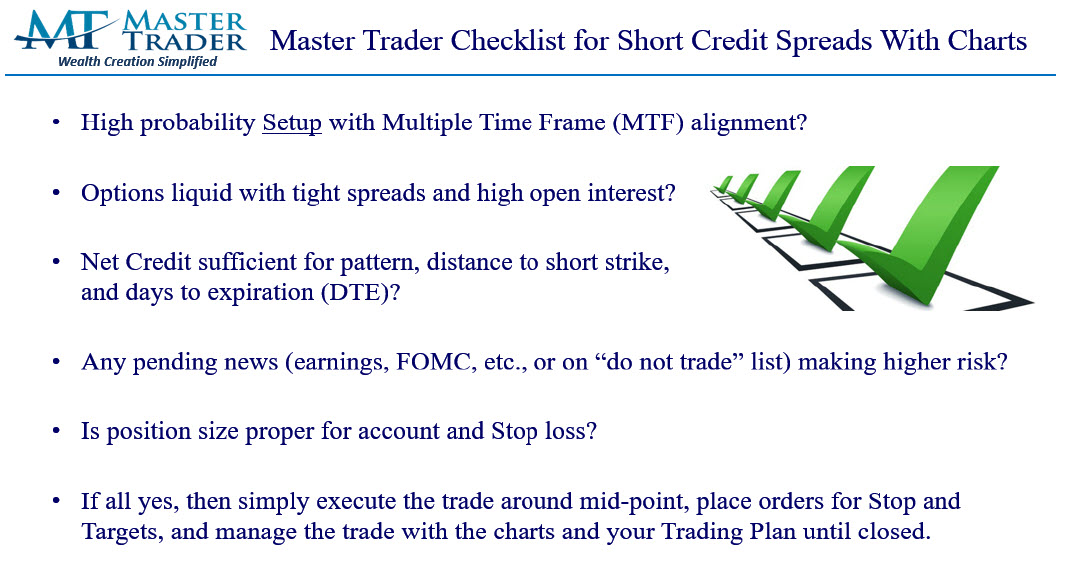
Here's our Checklist for shorting options/spreads using MTS. Spreads have unfortunately been wider than normal recently which is why the number of trades recommended in this letter has been fewer than normal. Additionally, when the VIX is low, the premium received has not been attractive. Most of you also subscribe to our Advisory Swing and Options Letter and, as you can see, we have many Directional ideas.
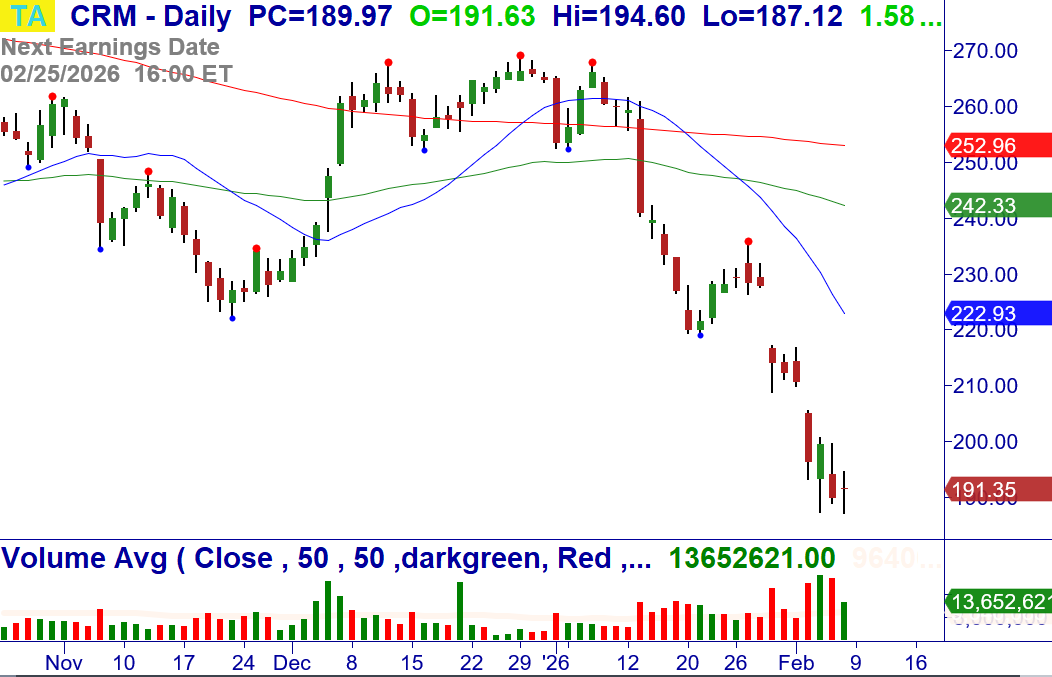
2/9: EOSE – Over $12.37, consider shorting Feb (2/13) $11/9.5 bull put credit spread for a limit of $.20/share (closed at $.23/share). Climactic Buy Setup and +180 reversal on Major Support. Stop $10.98 (however, stop out of position if the “debit/cost to close” the spread reaches 2x premium received, which would be $.40/share in this case, which means that you are not risking more than 1:1).
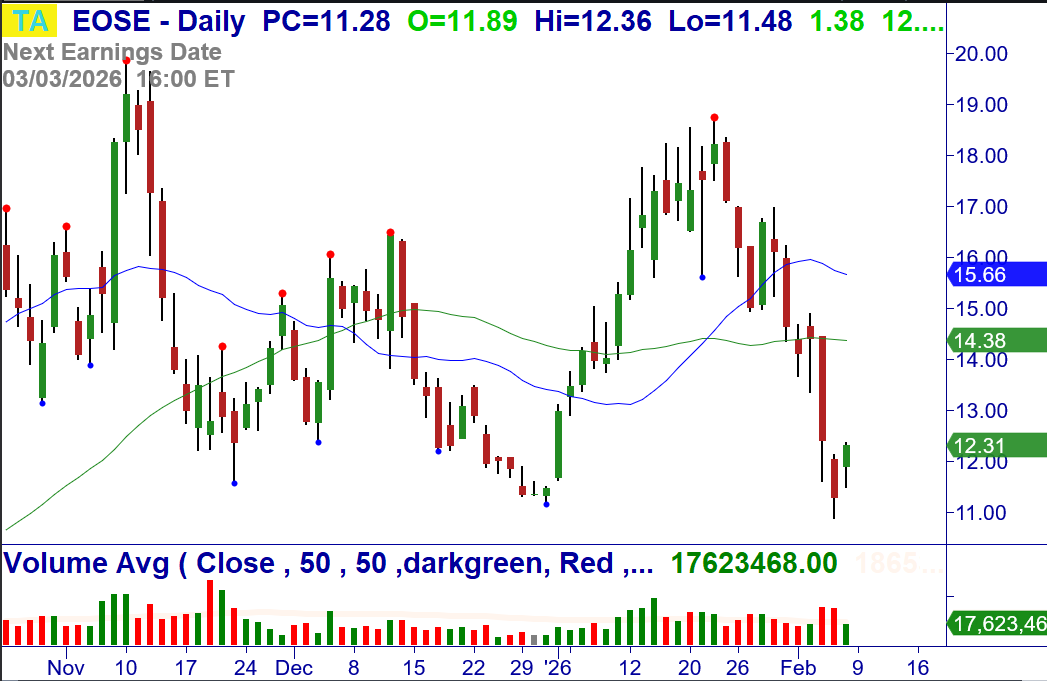
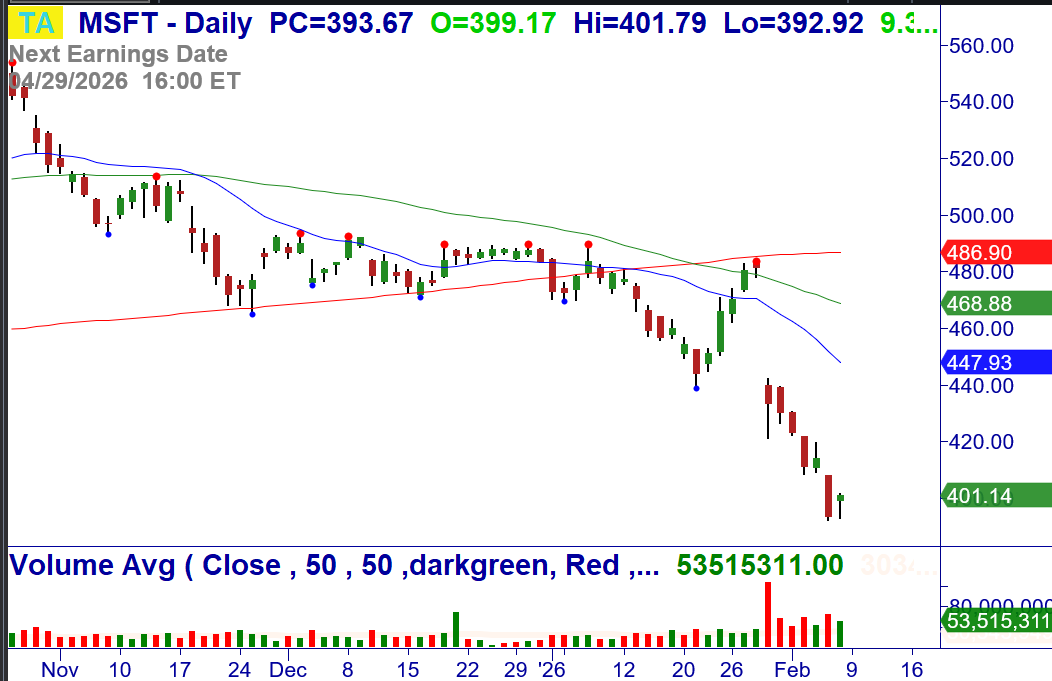
NOTE: We found many compelling patterns for directional trades which are contained in our Advisory Swing and Options Trader, see below. All directional patterns are credit spread CANDIDATES provided they are liquid and have attractive net credit for the DTE. In this case, every one of these unfortunately have illiquid options, preventing us from presenting credit spread ideas.

As you know, by selling spreads on stocks and ETFs where MTS indicates price is unlikely to go, we become the “smart money,” getting paid to take calculated, well-defined risk.
Check out the blog article with more information and monthly results, CLICK HERE
Professional consistency, short-duration trades, and risk-controlled income — that’s what defines the Master Trader approach.
Master Trader and You Building Your Financial Future Together!
Happy trading! If you have any questions or comments, please e-mail Greg Capra at Greg@mastertrader.com or Dan Gibby at Dan@mastertrader.com
All the best,
Greg Capra Managing Director of Master Trader
Dan Gibby Chief Options Strategist
NOTE: Master Trader will show the opening and closing prices of all stock and options trades. We recommend that all traders and investors use proper share sizing for positions and money management. However, we cannot recommend what that is for your particular trading style, risk tolerance, or account balance. We urge you to calculate your own share/position size based on your individualized risk parameters, Trading Plan, and familiarity with the proposed trade strategy and risk. Advanced Management Strategies (AMS) covers in detail foundation and advanced position and money management.
NOTE: Master Trader and its representatives may have existing positions in actual or other trade recommendations before or after suggested herein. Additionally, we may manage them differently for internal purposes based on different risk parameters than noted herein. All trade ideas and content are for informational and educational purposes only. It is not, nor is it intended to be, trading or investment advice or a recommendation that any security, option, or investment strategy is suitable for any person. Trading securities can involve high risk and the loss of any funds. Significant gaps or volatility can increase these losses, particularly for short option strategies. Investment or trading information provided may not be appropriate for all investors, and is provided without respect to individual financial sophistication, financial situation, investing time horizon or risk tolerance. Supporting documentation for any claims (including claims made on behalf of options programs), comparison, statistics, or other technical data, if applicable, will be supplied upon request. Master Trader Consulting, Inc. is not a licensed financial advisor, registered investment advisor, or a registered broker-dealer. Options, futures, and futures options are not suitable for all investors.