The Bond Market Is Testing Washington
What rising long-term interest rates may be telling investors—and the market signals that matter next.
Something important is happening beneath the stock market.
While investors naturally focus on the S&P 500, Nasdaq, earnings and individual stocks, one of the world's most important markets is sending a warning: the U.S. Treasury market.
Long-term yields have pushed higher while federal debt has climbed above $40 trillion. Treasury is responding by expanding liquidity-support buybacks in longer-dated bonds. The central question is no longer theoretical:
Is the bond market beginning to force Washington's hand—and what happens to stocks if long-term rates continue higher?
Macro Snapshot
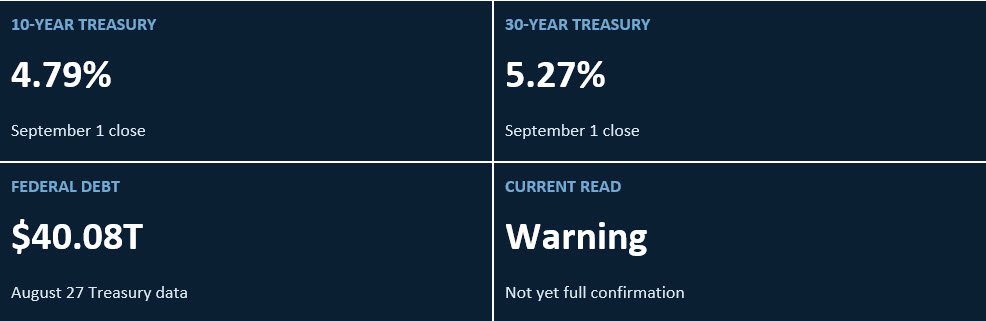
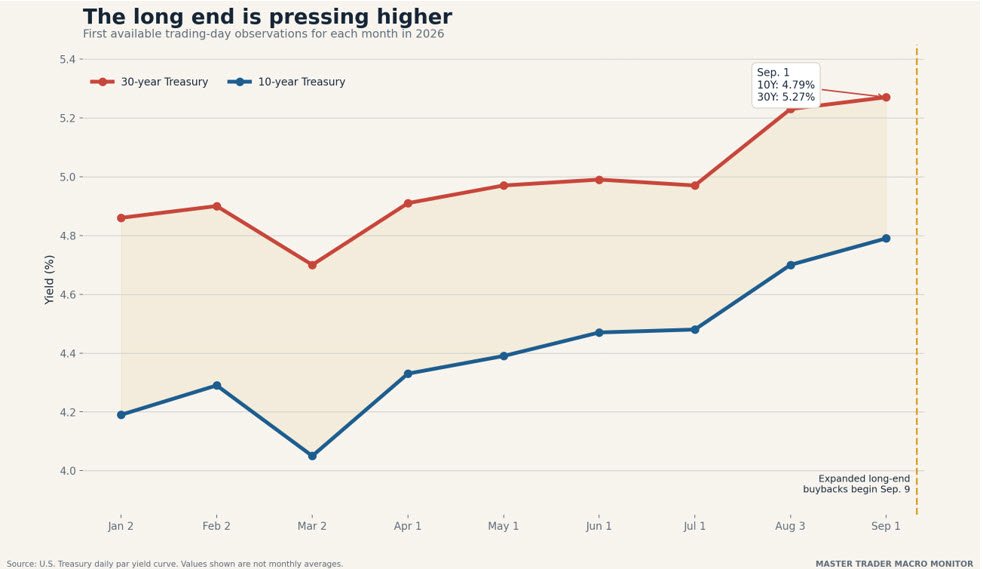
Updated September 2, 2026: The long end remains under pressure. The latest official Treasury observations show the 10-year at 4.79% and the 30-year at 5.27% on September 1. The warning has not yet become a full credibility event, but the combination of higher yields, a $40 trillion debt load, and renewed energy inflation deserves close attention.
Why the Long End Matters
The Federal Reserve can directly control the overnight policy rate. The 10- and 30-year Treasury yields are different. They reflect what investors require after weighing inflation, deficits, Treasury supply, foreign demand, economic growth, currency risk and the extra compensation needed to hold long-duration debt.
That makes the long end a confidence gauge for U.S. fiscal and monetary policy.
Investors are being asked to absorb enormous government borrowing while inflation remains a concern and large private borrowers—especially companies funding AI infrastructure, defense and reshoring—compete for capital. Traditional price-insensitive buyers such as foreign central banks are also less dominant than they once were.
Simply stated: the government needs buyers, and buyers are demanding higher yields.
Treasury Is Responding
Beginning September 9, Treasury will at least double the maximum size of certain liquidity-support buybacks involving 10- to 30-year securities, from $2 billion to at least $4 billion per operation through the current refunding quarter.
These buybacks are not the same as Federal Reserve quantitative easing. Treasury is repurchasing and managing existing government debt; QE would involve the Fed expanding its balance sheet to purchase securities.
But the market test is clear. If long-term yields fall after the expanded buybacks and remain lower, Treasury may have bought itself time. If yields retreat briefly and then make another higher high, the market may be signaling that a liquidity tool is too small for a structural fiscal and inflation problem.
What Could Washington Do Next?
Policymakers still have several options. They could increase buybacks again, change the maturity mix of Treasury issuance, establish a credible path toward smaller deficits, stop quantitative tightening, add liquidity facilities or—if market functioning becomes disorderly—have the Federal Reserve buy longer-duration Treasuries.
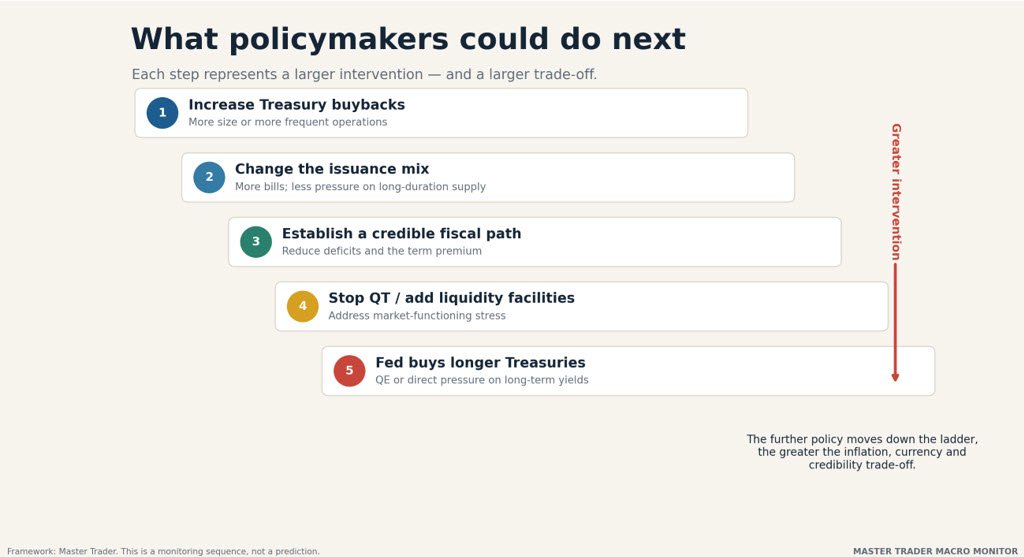
A macro thesis associated with Cem Karsan goes further, suggesting that the U.S. could eventually move toward long-end QE and a much larger sovereign investment vehicle. There is a factual basis for monitoring this: a 2025 executive order directed Treasury and Commerce to develop a plan for a U.S. sovereign wealth fund.
However, a multi-trillion-dollar government equity-buying program remains a hypothesis, not established policy. We do not need to predict exactly what Washington will do. We can let the markets—and actual policy decisions—tell us.
Master Trader Macro Monitor
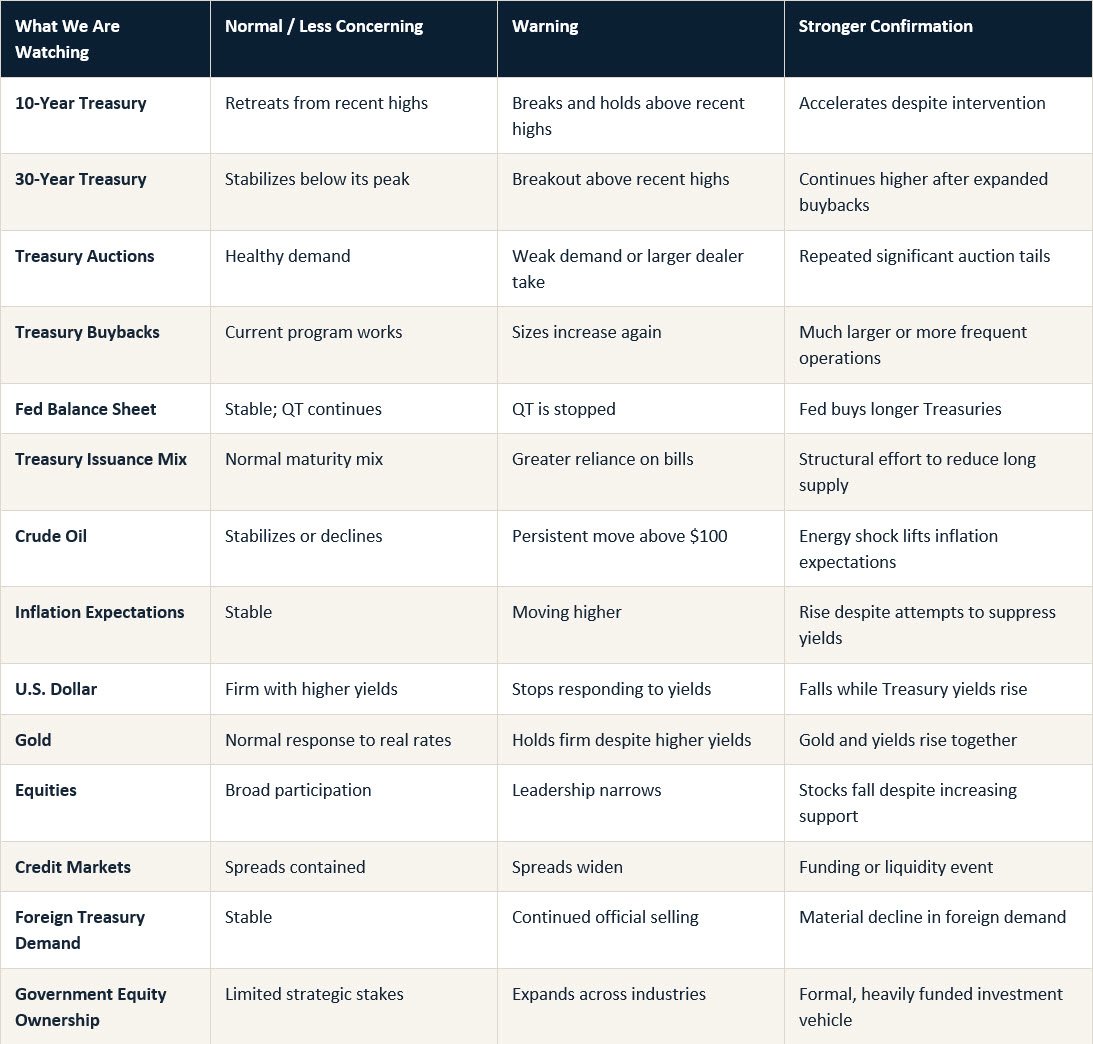
The dashboard below turns the thesis into objective reference points. Each week, the task is to identify what changed and whether the evidence remains normal, moves into warning, or provides stronger confirmation.
The Combinations Matter
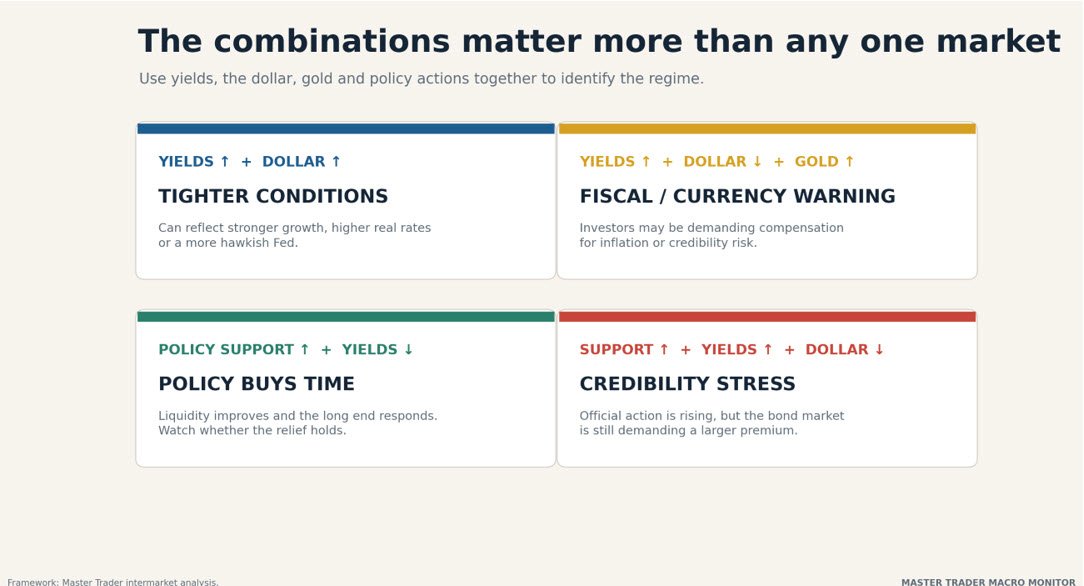
Higher yields alone do not prove a fiscal crisis. Yields rising with a stronger dollar can still reflect tighter policy, stronger growth or rising real rates. A more concerning combination is yields up, the dollar down and gold up. That can indicate investors are demanding compensation for inflation, fiscal or currency risk.
The most important warning would be increasing government intervention while bonds continue to fall, yields continue to rise, the dollar weakens, and gold strengthens. That would suggest the official response is not large enough to restore confidence.
GEOPOLITICAL WATCH
Venezuela, Iran, Israel and China
This deserves attention, but it should remain separate from the Treasury thesis until stronger evidence connects the two.
Venezuela
Recent U.S. policy has increased American involvement in Venezuela's oil industry and displaced some Chinese and Russian interests. That supports a broader interpretation involving energy security, strategic assets, and competition with China.
What remains unclear is whether Venezuelan oil revenue is systematically used to purchase U.S. Treasuries or finance a broad government equity portfolio. That remains a hypothesis to monitor—not a fact to assume.
Iran, Israel and China
The Iran conflict is tied to the wider confrontation involving Iran, Israel and the United States. Its market importance extends beyond the military conflict because of Iran's role in energy markets and the Strait of Hormuz.
China has been Iran's main remaining crude buyer. Restrictions on Iranian exports therefore pressure a source of discounted energy for China. But that does not mean cutting China off from Iranian oil is the primary driver of the conflict.
Market transmission: Israel/Iran conflict → oil-supply risk → higher oil prices → higher inflation risk → pressure on Treasury yields and Fed policy.
What Could Break the Current System?
Scenario 1: The Bond Market Wins
Long-term yields continue higher. Mortgages and corporate financing become more expensive. Equity valuations compress, and stress eventually appears in housing, banking, credit or leveraged finance. Washington must then decide how aggressively it is willing to intervene.
Scenario 2: Policymakers Suppress Rates
Nominal long-term rates are held below what the market would otherwise demand. The pressure moves into lower real rates, a weaker dollar, or persistent inflation. Gold and other hard assets may benefit while savers and bondholders lose purchasing power.
Don't Predict—Monitor
Plenty of dramatic forecasts exist about debt, inflation, the dollar, sovereign wealth funds, wars, and government intervention. At Master Trader, we believe there is a better approach:
Observe the evidence. Identify the important reference points. Develop a bias. Then let price action confirm or reject it.
That is true when analyzing an individual stock, and it is equally true when evaluating the global financial markets.
Right now, one of the most important charts investors may not be watching is not Nvidia, Apple, or the S&P 500. It is the long end of the U.S. Treasury market. The expanded buybacks beginning September 9 will provide the next important piece of evidence.