Below is a recent trade setup from the Master Trader Swing and Options Trader Letter. In this Chart of the Week, I want to show why OKTA was selected and, more importantly, how the Master Trader Technical Strategies thought process is used to identify higher-probability swing trades.
More...
Successful swing trading is not about chasing movement, reacting to headlines, or relying on one indicator. It is about combining multiple objective concepts in the time frame being traded.
For swing traders, the primary time frames are the weekly and daily charts. When those time frames align, and the daily chart creates a tradable setup, the odds of follow-through improve.
Of course, no setup is guaranteed. Professional traders accept that uncertainty. That is why every trade must have a defined entry, stop, and management plan before the trade is taken.
The MTS Thought Process
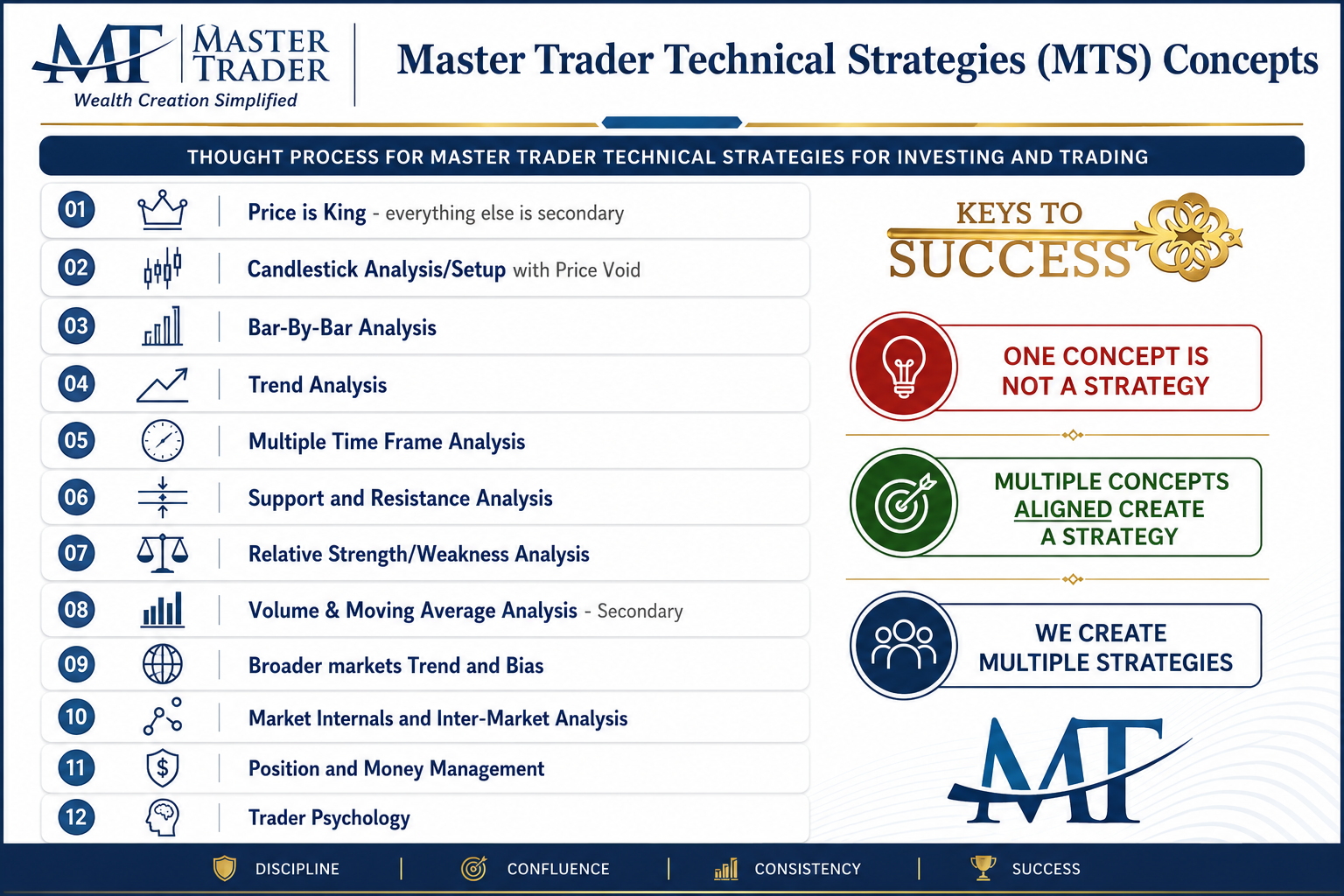
Master Trader Technical Strategies are built around core concepts such as trend, support and resistance, candlestick analysis, multiple time frames, relative strength, volume, moving averages, market internals, and position management.
One concept alone is not a strategy.
A strategy is created when multiple concepts align and point to the same conclusion.
For swing trading, most setups fall into one of three categories:
Trend Trades — buying pullbacks or breakouts in an established uptrend, or shorting rallies and breakdowns in a downtrend.
Counter-Trend Trades — trading a reversal against an extended move.
Continuation Trades — entering as price resumes movement after a pause or consolidation.
OKTA was a trend trade.
The goal was not to predict a bottom or buy weakness blindly. The goal was to identify a stock showing strong institutional demand, then wait for a controlled pullback and a confirming reversal pattern.
Why OKTA Was Chosen
Several MTS attributes came together:
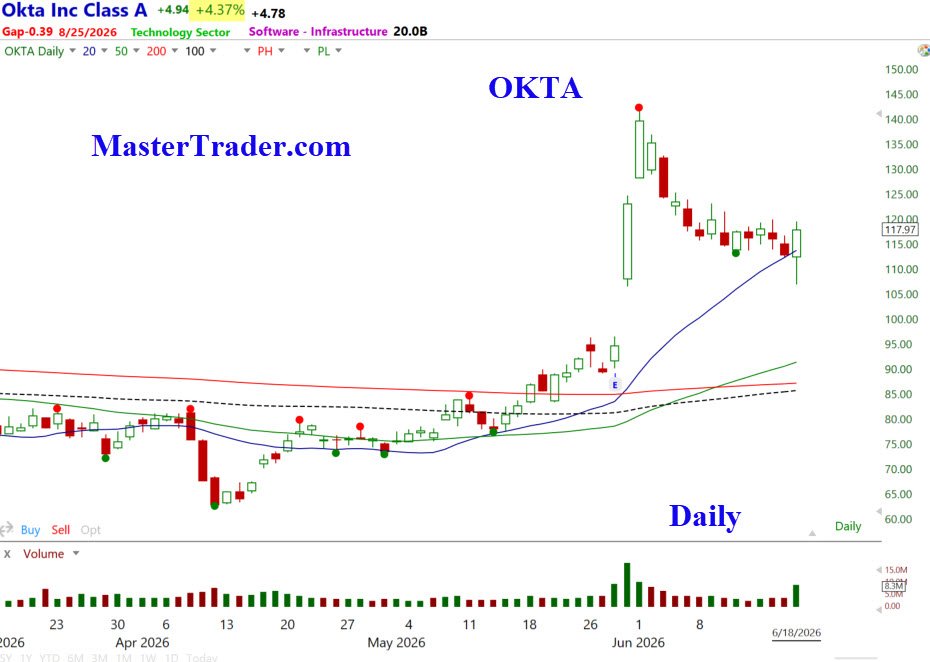
The weekly and daily time frames were aligned.
Price broke out of a consolidation after earnings.
The breakout occurred on explosive volume, showing strong demand.
After the breakout, OKTA pulled back toward the rising 20-day moving average.
The moving averages were stacked in bullish alignment, with the shorter moving averages above the longer ones.
Most importantly, the current candle briefly broke the recent consolidation below and then reversed the breakdown completely.
That type of candle is a Range Expansion Bottoming Tail bar. It is also a form of shock bar, which is covered in detail in the Master Trader Bar-by-Bar course. The course is included in the Swing Trader Bundle
The bar initially suggested weakness, but when price reversed back up, it showed that sellers could not maintain control. That failure can become an important bullish signal when it happens in the right location and within the right trend.
The Setup
OKTA had the right ingredients:
A higher-time-frame bullish bias.
A strong earnings breakout.
A controlled pullback.
Support near a rising moving average.
Bullish moving average alignment.
A failed breakdown that reversed back up.
That does not guarantee the trade will work. Nothing does.
However, when multiple MTS concepts align, the probability of a successful swing trade improves. The next step is to define the trigger. OKTA would still need to trade above a key level to confirm the entry. Once triggered, the trade would have a defined stop and would be managed according to the plan.
Learn the Process Behind the Trade
The Master Trader Swing and Options Trader Letter focuses on opportunities designed to last approximately 1 to 10 days. Trades are updated intraday, and subscribers receive text alerts for entries, profit-taking, stop adjustments, and exits.
The Letter shows the trades.
The Swing Trading Bundle teaches the thought process behind them.
If your goal is to become a more objective, self-reliant swing trader, the Swing Trading Bundle will teach you how to evaluate setups like this professionally using Master Trader Technical Strategies.
If you have found this post helpful, Share it Forward with other Traders
All the best
Greg Capra