
Has the Pain Become Great Enough to Follow a Trading Plan?
Most new traders enter the market searching for a method.
They want to know which patterns work, which time frames to use, and how to find the next large move. That search is understandable. The goal is to make money.
Yet many begin placing trades before they have developed a complete method. They act on opinions, headlines, tips, emotions, isolated chart patterns, or the fear of missing out.
Without defined rules for entering, managing, and exiting a trade, that is not professional trading.
It is gambling.
A trader may occasionally make money this way, but random success creates a dangerous illusion. A profitable trade does not prove the decision was correct. It may simply mean the market temporarily rewarded undisciplined behavior.
Eventually, the market exposes the difference between luck and skill.
Learning a Method Is Only the Beginning
Some traders move beyond random decision-making. They invest the time to learn a method, understand price patterns, analyze trends, identify support and resistance, and create a trading plan.
That is an important step.
However, knowing what to do and consistently doing it are very different things.
A trader may have a written plan and still take trades that do not qualify. They enter before confirmation, chase an extended move, trade into support or resistance, ignore multiple time frame conflict, increase size after a loss, or hold beyond the planned stop.
Why?
Because the focus shifts from executing the method to producing money.
The trader stops asking:
“Does this trade meet my criteria?”
And starts asking:
“How much can I make?”
That change in focus is where discipline often begins to break down.
Trading Is Not Like Most Jobs
In a traditional job or business, more activity is often associated with greater productivity. More calls, meetings, projects, and hours may lead to better results.
Trading does not work that way.
Trading activity is not the same as trading productivity.
One trader may place ten trades and accomplish nothing other than increasing stress, commissions, and risk. Another may wait several days, take one high-quality opportunity, and produce a better result.
Professional trading is not about constantly doing something.
It is about acting when the odds are favorable and remaining inactive when they are not.
That is difficult for many traders to accept. Sitting in front of a screen without placing a trade can feel unproductive. Watching prices move without participating can create anxiety. Seeing someone else post a profit can create pressure to act.
However, waiting is part of the job.
A trader is paid for making quality decisions, not for pressing the buy and sell buttons.

Trading Is an Opportunistic Business
Trading can be feast or famine.
There are periods when market conditions align, and opportunities appear regularly. Trends are clean, multiple time frames support one another, price patterns develop properly, and the distance to the next support or resistance area creates favorable reward relative to risk.
During those periods, profits may come quickly.
There are also periods when the broader market moves sideways, sectors rotate erratically, breakouts fail, gaps reverse, and time frames conflict.
During those periods, the best decision may be to trade less, reduce position size, or wait.
That waiting can last longer than expected.
This is where discipline is tested.
A lower-quality setup starts to look acceptable. A trade that does not meet the plan gets rationalized. The trader says, “This one is close enough.”
Usually, it is not.
The MTS Approach: Conditions First, Opportunity Second
Master Trader Technical Strategies begins with an objective evaluation of market conditions.
Before considering a trade, the trader should understand:
- The trend
- Major support and resistance
- Multiple time frame alignment
- The current price pattern
- The distance to the next obstacle
- Whether a Price Void exists
- The broader market and sector environment
- The acceptable risk and position size
- The entry, stop, target, and management plan
This process shifts the focus away from prediction and toward preparation.
The trader is not trying to know with certainty what will happen next. No method can provide certainty.
The goal is to determine whether current conditions offer a favorable opportunity.
When those conditions are not present, there is no trade.
That decision is just as important as selecting an entry.
The Market Does Not Owe You a Trade
One of the most damaging beliefs in trading is that money must be made every day.
The market does not operate according to your financial goals, your schedule, or your need for income.
It does not know that you had a losing week, missed the previous move, or want to make a specific amount before the end of the month.
The market simply presents changing conditions.
Your responsibility is to recognize whether those conditions match your plan.
When traders feel pressure to produce, they often force trades. They act because they want an opportunity to exist, not because one actually exists.
That is when the plan becomes secondary and emotion takes control.
Following the Plan Can Be Uncomfortable
Following a trading plan does not eliminate emotional discomfort.
It may mean watching a stock move without you because the entry did not meet your rules.
It may mean taking a small planned loss and then seeing the stock reverse.
It may mean exiting with a reasonable profit and watching the position continue higher.
It may mean sitting in cash while others appear to be making money.
However, the discomfort of discipline is very different from the pain created by undisciplined trading.
The discomfort of following a plan is temporary and controlled.
The pain of repeatedly breaking the plan can become financial, emotional, and destructive.
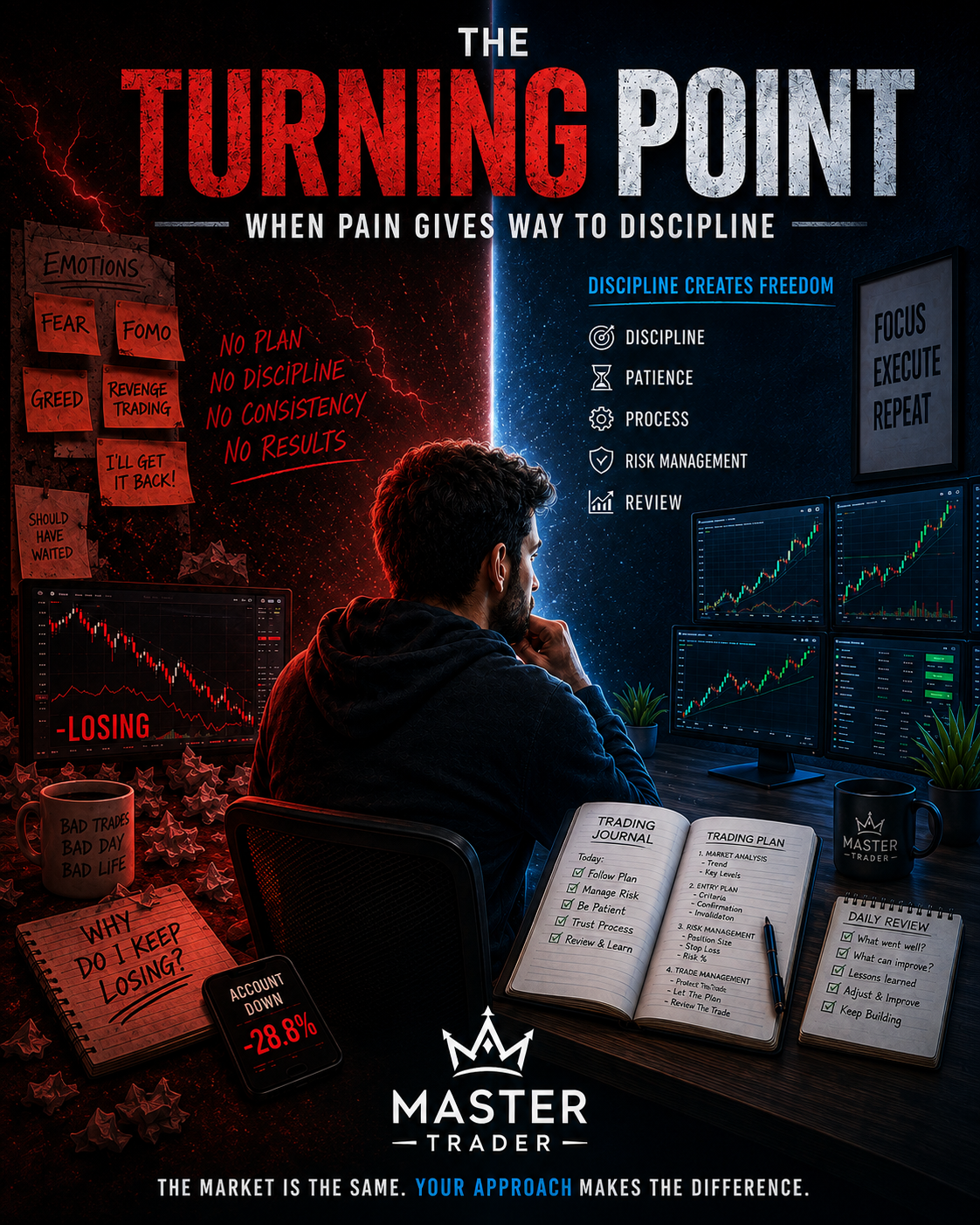
For many traders, discipline does not develop simply because they understand that it is important.
It develops when the pain of doing the wrong thing becomes greater than the discomfort of doing the right thing.
After enough impulsive entries, oversized positions, ignored stops, revenge trades, and unnecessary losses, the trader reaches a turning point.
At that point, one of two things usually happens.
The trader quits.
Or the trader finally accepts that success will not come from finding more trades, predicting every move, or forcing the market to provide income.
Success will come from following a defined process.
The trader begins to understand that every trade is only one event in a long series of probabilities. No individual trade has to work. The goal is not to be right on every trade.
The goal is to execute a method with positive expectancy over time.
That change in thinking is critical.
Measure Execution, Not Just Profit
A well-executed trade can lose money.
A poorly executed trade can make money.
That is one of the most confusing realities of trading.
If a trader judges every decision only by the financial result, bad habits can be reinforced. The trader may break the plan, make money, and conclude that the decision was correct.
It was not.
The better question is:
“Did I follow my plan?”
A professional trading journal should record whether the setup met the defined criteria, whether the market and sector supported the trade, whether the time frames were aligned, whether the entry was properly timed, whether position size was appropriate, and whether the trade was managed according to the plan.
It should also identify whether fear, greed, urgency, frustration, or the need to make money influenced the decision.
Profits should be the long-term result of executing a sound method with discipline—not the only measure of performance.
Confidence Comes From Repetition
Real trading confidence does not come from one large winning trade.
It comes from repeatedly following the same process.
When traders consistently apply the MTS approach, they begin to trust their ability to evaluate trends, support and resistance, multiple time frames, Price Voids, market internals, sector strength, and risk.
That trust is built one properly executed trade at a time.
The trader becomes less dependent on opinions, predictions, and emotional reactions. They no longer need to participate in every move.
They understand that another opportunity will come.
They become willing to wait.
Professional trading is defined by discipline.
A professional trader knows what qualifies as an opportunity before the trade is entered. The risk is defined in advance. The position is managed according to a plan, not according to fear, hope, or the need to recover a loss.
Most importantly, the professional accepts that doing nothing is sometimes the correct decision.
The goal is not to eliminate losing trades. That is impossible.
The goal is to eliminate avoidable losses caused by breaking the plan.
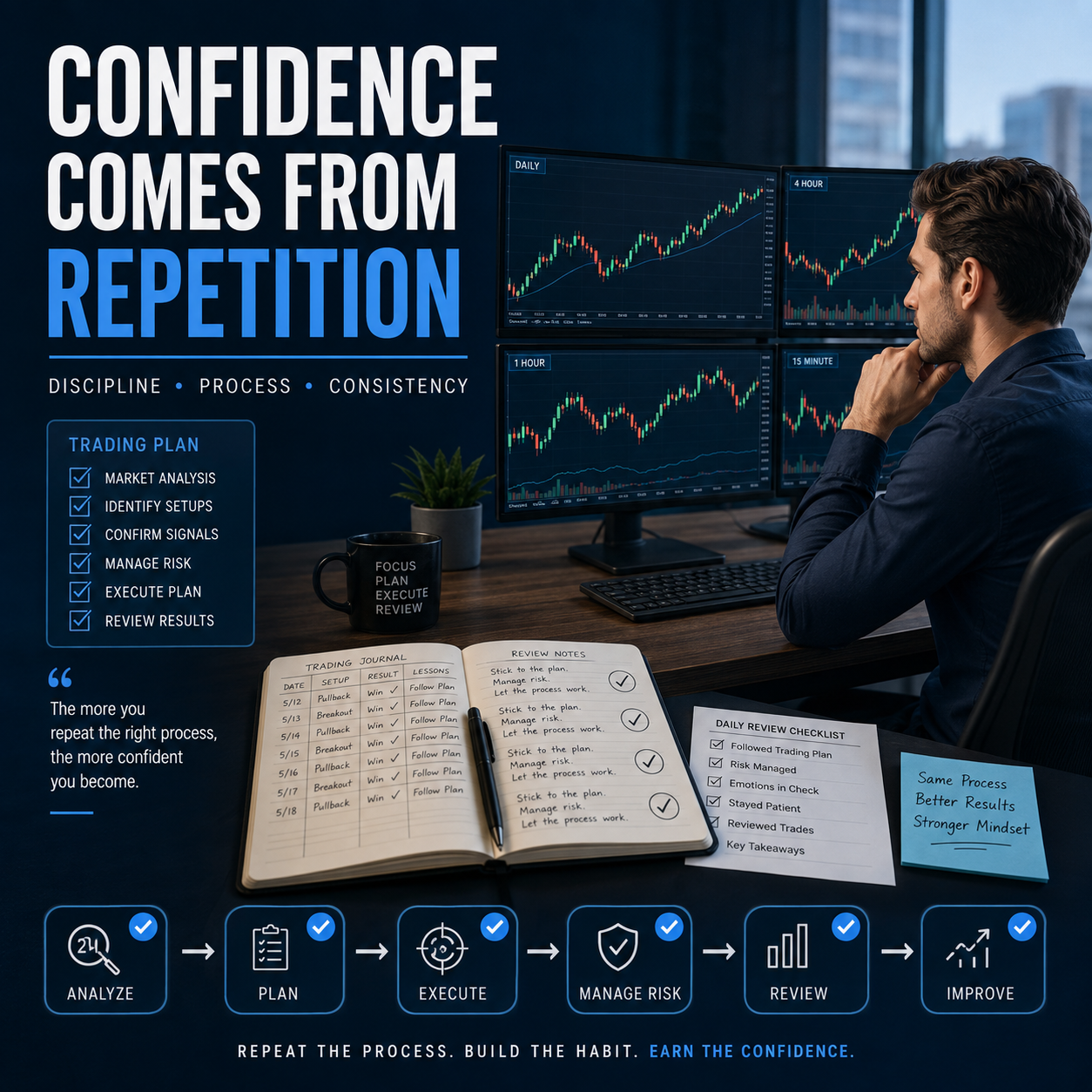
Master Trader Students and Subscribers attend monthly coaching sessions or watch the recording. That is part of the Repetition provided to reinforce what is learned in the course, and letters. Those sessions build confidence and help you attain your financial goals.
Has the Pain Become Great Enough?
Every trader eventually faces this question.
Has the pain of inconsistent results become great enough?
Has the pain of impulsive decisions become great enough?
Has the pain of repeating the same mistakes become great enough?
Has the pain of knowing what to do, but not doing it, become great enough?
When the answer is yes, the trader is ready to change.
The focus moves away from making money on the next trade and toward executing the method correctly.
The trader stops trying to force opportunities and begins waiting for them.
The trader accepts that trading is an opportunistic business. There will be periods of activity and periods of patience. There will be winning trades and losing trades. There will be times when conditions align and times when the correct decision is to stand aside.
The pain does not disappear.
It changes.
Instead of experiencing the uncontrolled pain of gambling, the trader accepts the temporary discomfort of discipline.
That is the point where trading becomes professional.
It is also where consistent success becomes possible.
Develop the Discipline to Trade Professionally
Master Trader education is designed to help traders move beyond opinions, predictions, and random decision-making.
Through Master Trader Technical Strategies, Techno-Fundamentals, Multiple Time Frame Analysis, the Price Void concept, position and money management, and trader psychology, you learn how to objectively evaluate both the opportunity and the environment surrounding it.
A method provides the structure.
A trading plan provides the rules.
Discipline turns those rules into consistent action.
The market will always offer another opportunity.
The question is whether you will have the patience to wait for the right one—and the discipline to follow your plan when it appears.
If you have found this post helpful, Share it Forward with other Traders. All the best Greg Capra