Swing Trading Isn’t Investing
Putting Swing Trading in Perspective with Master Trader Technical Strategies
Swing trading is often misunderstood.
Many people come to the market thinking swing trading is simply a shorter-term version of investing. It is not.
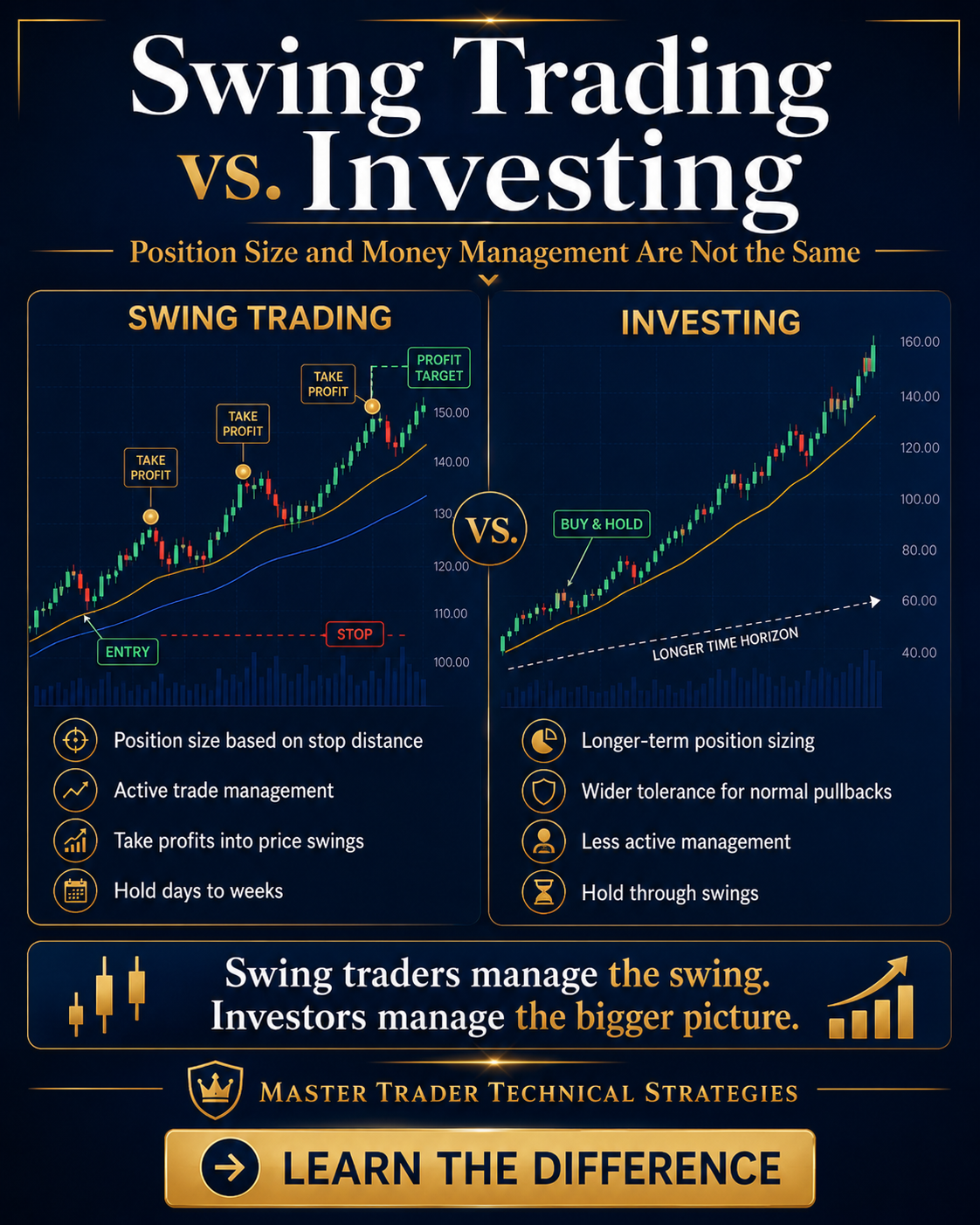
Investing is generally based on a longer-term view. The investor may be willing to hold through pullbacks, news events, earnings, and periods of uncertainty because the objective is longer-term appreciation.
Swing trading is different.
Swing trading is pattern-based, time-sensitive, and risk-managed. The swing trader is not buying a story and hoping it works out over months or years. The swing trader identifies a price pattern, defines the entry and stop, manages the position, and accepts that the trade either works within the expected structure or it does not.
That is an important distinction.
At Master Trader, swing trading is taught through Master Trader Technical Strategies, or MTS. The focus is on price, trend, support and resistance, multiple time frames, and pattern quality.
More...
Primarily, swing trading is trend trading.
An uptrend is defined by higher highs and higher lows. A downtrend is defined by lower highs and lower lows. As long as that structure remains intact, the current trend is given the benefit of the doubt.
With that in mind, a swing trader will typically look to buy pullbacks in an uptrend, short rallies in a downtrend, or trade breakouts and breakdowns when the pattern supports the decision.
However, not all trends are equal.
One of the most important lessons in MTS is learning to recognize the quality of a trend. A trend can be technically intact yet erratic, sloppy, wide, and difficult to manage.
Another trend may be smooth and controlled, displaying a high degree of certainty.
That difference matters.
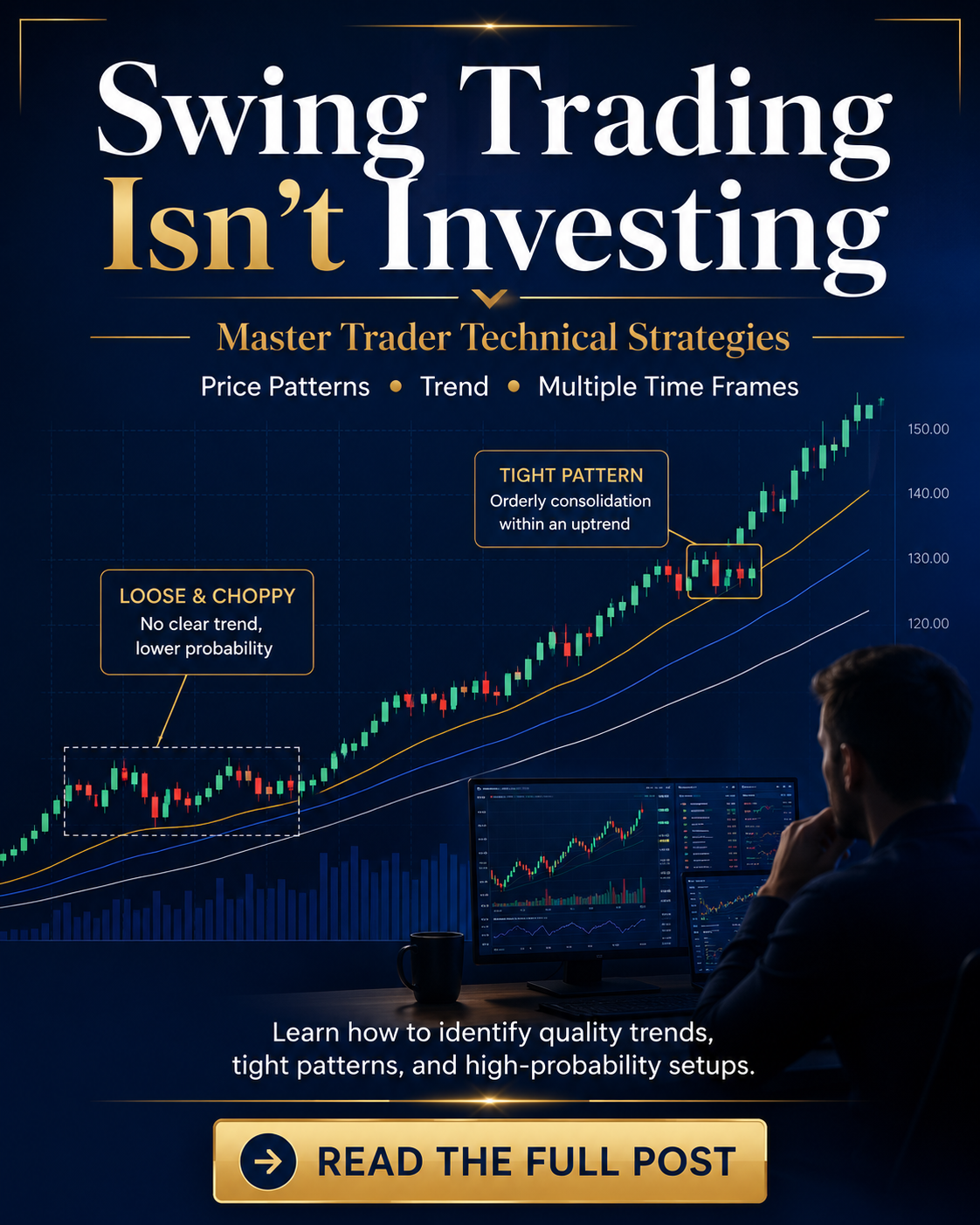
A quality trend has fluid price movement. The candles or bars tend to move in an organized way. Pullbacks are controlled. Support and resistance areas are easier to define. The trader can identify where the trade should work and where it is no longer valid.
A lower-quality trend is different. It may still be moving higher or lower, but the price action is loose. There may be overlapping bars, wide ranges, gaps, failed moves, and constant uncertainty from bar to bar.
This is where many traders get frustrated.
They may be correct about the direction, but still lose money because the pattern is too loose, the stop is too tight, or the position size is too large relative to the amount of “wiggle room” the stock requires.
That leads directly into money management.
If multiple time frames are aligned in the direction of the trade, the odds may favor continuation. But if the pattern lacks quality, the trader has to decide whether the trade deserves more room, a smaller position size, or no trade at all.
This is one of the reasons Master Trader emphasizes multiple time frames.
The daily chart may show the swing trading opportunity, but the weekly chart provides the larger context. The intraday chart may help refine the entry, confirm the pattern, or show whether buyers or sellers are taking control.
When multiple time frames are aligned, the odds improve.
Stacked moving averages can also help visually confirm the direction of the trend. When moving averages are properly aligned and price is respecting them, the odds favor the current trend continuing. But moving averages are not the reason for the trade. They are a visual aid. Price pattern comes first.
At Master Trader, we scan for quality patterns.
Quality patterns are usually tight. The price bars or candles are arranged in a way that shows agreement among market participants. The pattern is not random. It is organized. It tells us that buyers or sellers are gaining control.
Loose patterns tell a different story.
Loose patterns often have overlapping bars, wide swings, gaps, and unclear direction. From bar to bar, the trader is guessing. That is a picture of uncertainty.
Swing traders want clarity.
That clarity comes from identifying the trend, the quality of the pattern, the location of support or resistance, and the correct entry and stop.
There are different types of swing trading patterns.
Climactic patterns are usually counter-trend trades. They occur after an extended move when price becomes stretched, emotional, and vulnerable to reversal. These can be powerful trades, but they require more skill and more confirmation.
Ideally, a climactic pattern will begin to stabilize before entry. That stabilization may take the form of several days of basing, a higher low, a reversal pattern, or an intraday structure that shows the prior move is losing momentum.
The key is this: swing trading is not about buying something because it is “cheap” or selling something because it is “too high.”
It is about pattern recognition, timing, confirmation, and risk management.
A swing trader must also accept one uncomfortable reality: good trades will not always work.
Sometimes the trade will stop out and then turn back in the original direction. Sometimes the stop will protect you from a much larger loss. Sometimes the market will change character quickly. That is part of trading.
The goal is not to be perfect.
The goal is to have a repeatable process.
That process should answer several questions before the trade is placed:
What is the trend?
Are multiple time frames aligned?
Is the pattern tight or loose?
Where is support or resistance?
Where is the entry?
Where is the stop?
How much room does the trade need?
What position size makes sense?
What would prove the trade wrong?
This is where Master Trader Technical Strategies help traders become more objective.
Instead of relying on opinions, indicators, predictions, or emotion, MTS teaches traders how to read price action and understand what market participants are doing.
Swing trading is a powerful way to participate in the market, but it must be understood for what it is.
It is not investing.
Swing trading is the disciplined execution of a pattern-based plan, using trend, multiple time frames, price structure, and risk management.
Know what you are trading.
Know the plan.
Accept the good and the not-so-good.
That is how a trader begins to think and operate like a Master Trader.