Internals at an Extreme — What It Really Means
Markets don’t bottom because price “looks low.” They bottom when emotion reaches an extreme—and that’s what the internals are now revealing. I covered internals and much more in the Advisory Letter.
Breadth has deteriorated sharply, reflecting a shift from controlled selling to emotion-driven liquidation, while sentiment has pushed to levels that historically align with fear and potential capitulation. At the same time, price is pressing into a meaningful support area, where institutions typically begin to step in.
This is where most traders misread the market.
They see weakness and expect more downside.
Professionals recognize that extremes in internals often occur near turning points—not in the middle of trends.
From an MTS perspective, the current environment suggests:
- Selling pressure is becoming exhausted rather than expanding, but may not be complete
- Weak hands are being forced out as fear peaks
- The risk/reward dynamic is beginning to shift in favor of opportunity
However—and this is critical—extreme readings are not a signal to act by themselves.
They define the setup, not the entry.
Current S&P 500 Chart with Breadth and Sentiment Internal Gauges
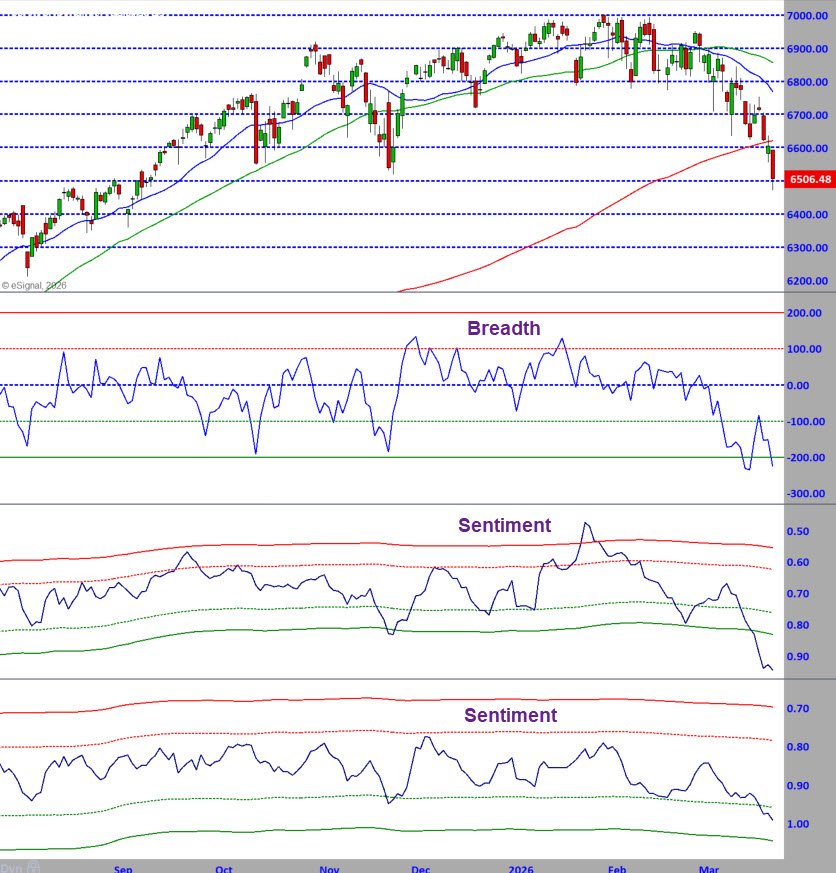

It’s important to keep this in perspective. A rally from extreme conditions does not necessarily mean a bottom is in—it simply means the market has reached a point where selling becomes temporarily exhausted, and a counter-trend move higher is not far off.
What we now look for is confirmation:
- Stabilization or improvement in breadth
- Sentiment beginning to reverse from extremes
- Price holding support and shifting from impulsive selling to controlled buying
That combination is what produces high-probability turning points.
Most traders react emotionally in this environment—selling into weakness and missing the reversal.
Master Traders do the opposite. They read the internal condition of the market and prepare for opportunity when others are focused on fear.
If you want to learn how to interpret these conditions in real time and align them with high-probability swing and options trades, the Advisory Swing & Options Letter walks through this process every week—covering market internals, key setups, and actionable trade ideas.
Don’t just react to the market—understand what’s driving it.