A Bar-by-Bar Profit-Taking Pattern Within a Powerful Trend
Most MTS patterns help us identify when a move is likely to continue over a shorter or longer time horizon.
Occasionally, however, a pattern serves a different purpose — it warns that even a strong trend may be vulnerable to a pause or shakeout.
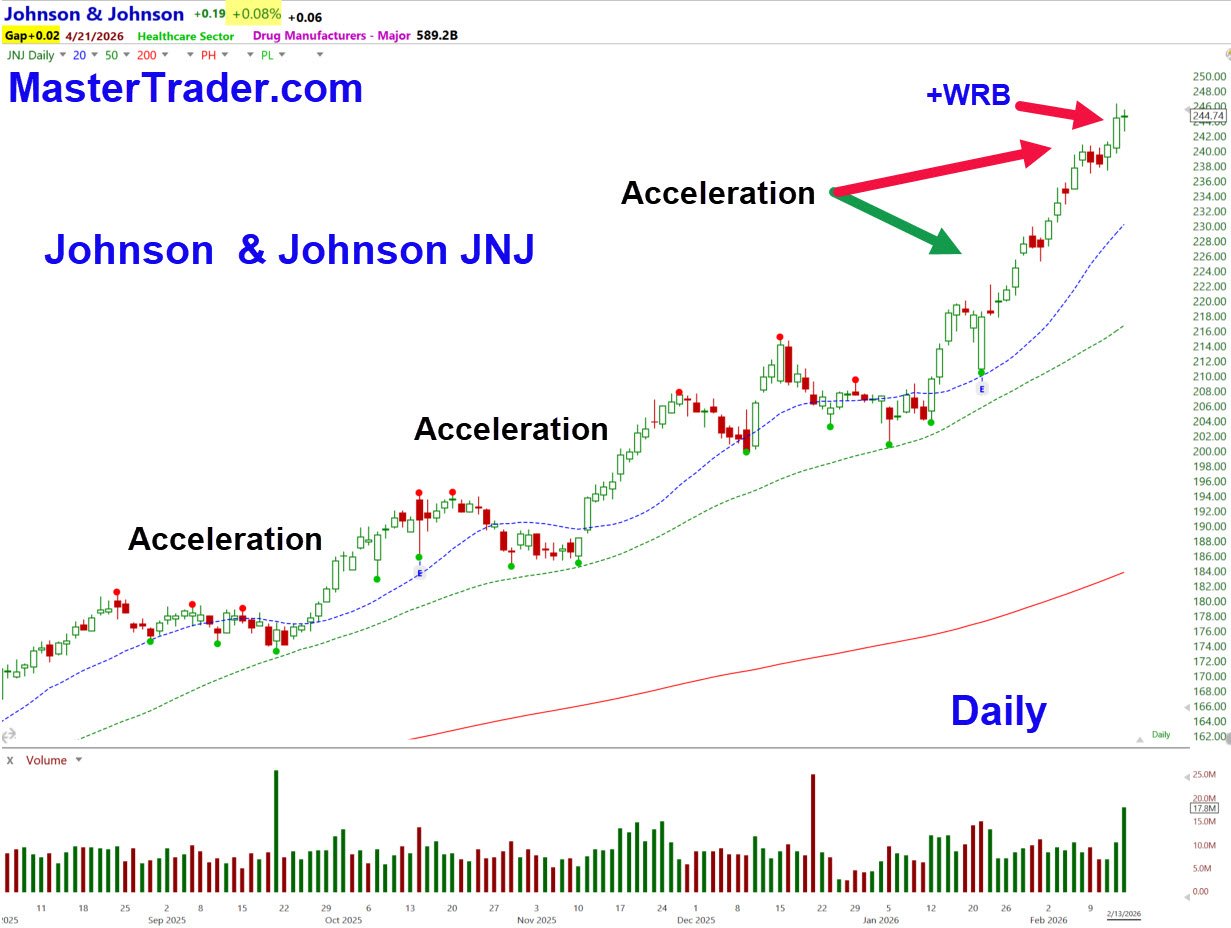
Johnson & Johnson provides a textbook example in the chart below.
Since the start of the year, J&J has been in a persistent uptrend, characterized by shallow pullbacks and tight consolidation pauses.
One of the clearest messages from the chart is the absence of meaningful pivot highs and pivot lows.
Master Trader Insight:
When trends advance with few or no pivots, it reflects persistent demand. Buyers are consistently willing to step in before meaningful pullbacks can develop.
The Current Pattern Structure
Last week, price paused in a brief sideways consolidation and then expanded higher with a bullish wide-range bar.
The following session formed a narrow-range bar near the highs — effectively a +123 continuation structure.
While two- or three-bar formations are not stand-alone trade signals, they become highly informative when viewed within the broader MTS context.
At face value, this is bullish behavior. Yet when it appears after an extended advance with visible acceleration, the message shifts from continuation to risk awareness.
Why Acceleration Matters
Acceleration late in a mature trend often reflects urgency — buyers chasing performance rather than initiating new structural demand.
Historically, this type of price behavior frequently precedes:
- A digestion phase
- A pullback toward support
- Or a breakout that fails before resuming the trend
Master Trader Insight:
Acceleration is not bearish by itself — but it often marks the point where reward-to-risk becomes less favorable for new longs.
What Would Change the Picture? A Breakout Bar Failure!
The first subtle warning would be a break below the inside bar low.
That action often triggers short-term profit-taking as momentum traders recognize that upside follow-through is stalling.
A deeper confirmation would be a close below the wide-range bar low, which would signal a developing breakout failure rather than simple consolidation.
Importantly, even a normal retracement would not violate the primary uptrend unless it began producing lower highs and lower lows.
Strategic Considerations for Long Positions
For traders already long, this is less about predicting a reversal and more about managing expectations.
Possible responses could include:
- Tightening trailing stops
- Reducing partial exposure into strength
- Generating income through covered calls
The objective is not to fight the trend, but to recognize when the character of price action shifts from accumulation to potential distribution.
The Bigger Master Trader Message
Every pattern represents the collective psychology of market participants.
In this case, the chart reflects optimism — but also the early signs that expectations may be running ahead of fresh demand.
The future path is never certain.
What matters is recognizing when the balance between opportunity and risk begins to change — and letting price guide decisions rather than predictions.
Understanding patterns like this is not about memorizing setups — it’s about learning how to read the story price is telling in real time. When you can recognize shifts in trend strength, momentum, and expectations, you move from reacting to markets to interpreting them with confidence.
If you find insights like this valuable, imagine seeing these patterns unfold live and knowing exactly how to respond.
Master Trader education is designed to help traders build the skills to analyze trends, manage risk, and make objective decisions using a proven bar-by-bar framework.
Whether you’re looking to master price action through the Bar-by-Bar Analysis course or learn how to apply these concepts to real trades in the Swing Trading course, the goal is the same — to give you a structured, repeatable process you can rely on in any market environment.
Learning how to read price action with structure and discipline can fundamentally change how you approach the markets — and that’s the outcome we work toward with our students every day.
I hope that you've found this helpful. If you have, consider sharing it with others.
Greg Capra