
The Advantages and Disadvantages of Trading Credit Spreads
Why Traders Use This Income Strategy—and What to Watch Out For
In the world of options trading, credit spreads remain a go-to strategy for traders looking to generate steady income with defined risk. Whether you're selling spreads weekly or stretching to two weeks out, the appeal is clear: you get paid upfront and you know your risk in advance. But like every strategy, credit spreads have strengths and weaknesses—especially depending on how you approach the markets.
At Master Trader, we integrate foundational technical analysis—trend, support, resistance, and price patterns—to decide where the price is unlikely to go by expiration.
That’s what makes credit spreads effective when used with a structured method. Simply relying on options Greeks, in our view, is like going to a gun fight with a knife. It’s not that the Greeks are useless; it’s that they’re incomplete without chart-based analysis of price behavior.
Let’s break down the advantages and disadvantages of trading credit spreads.
Advantages of Credit Spreads
1. Defined Risk and Reward
Every credit spread has a maximum loss and gain. You know exactly how much you can lose or make, which removes uncertainty. That’s a huge benefit for traders managing capital and emotions.
2. High Probability of Profit
Most credit spreads are placed out of the money (OTM). That means the trade only needs the stock not to reach a certain level. At Master Trader, we evaluate where the price is unlikely to go using our MTS method. This creates an edge in timing and accuracy.
3. Weekly, Biweekly, and Monthly Income
Weekly options make it possible to generate a consistent cash flow. Traders can sell spreads 1 to 14 days out, or longer, targeting high-probability setups, and repeat the process frequently.
4. Flexibility in Market Conditions
Credit spreads can be bullish (bull put spreads), bearish (bear call spreads), or neutral (iron condors or calendar spreads). That flexibility allows traders to adapt to changing market trends and volatility levels.
5. Can Be Used in IRAs
Because the risk is defined, many brokers allow credit spread trading in retirement accounts. This makes them attractive to investors who want to grow or generate income from retirement funds.
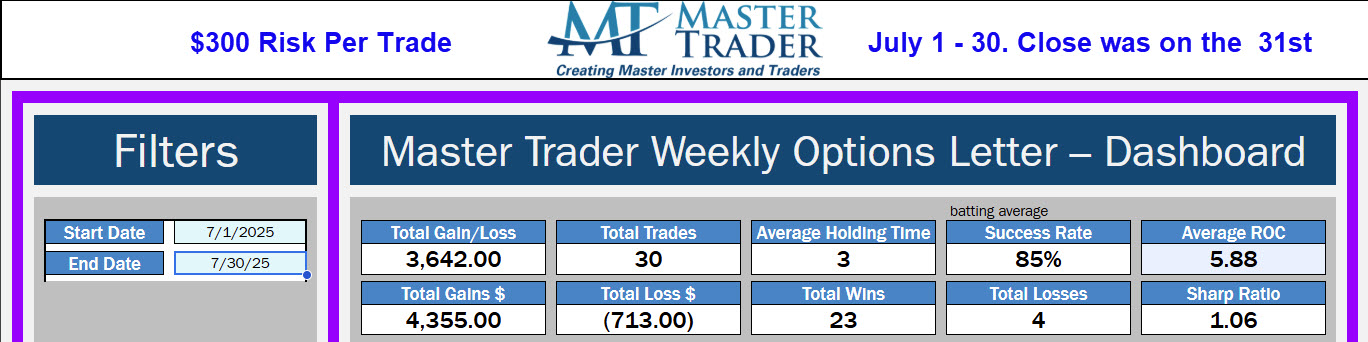
The MT Weekly Options Trader - a Great Way to Supplement Your Income
Disadvantages of Credit Spreads
1. Limited Profit Potential - We know that getting into the trade.
Your maximum gain is capped at the premium received. That’s the trade-off for having a high probability of success: you don’t hit home runs, you collect singles.
2. Requires Precise Timing and Entry - We find the trades and send them to you.
While the trade may look good on paper, the price can move quickly. Entering a spread too early or too close to support/resistance without technical confirmation can turn a high-probability trade into a loser. We require an MT reversal pattern, which there are many.
3. Margin Requirements
Though risk is defined, brokers still require margin based on the width of the spread. This can tie up capital, especially if you’re trading multiple positions at once.
4. Event Risk (Earnings, News, Gaps) - We always check the news before the trade.
Unexpected gaps against your position—often caused by earnings or macro news—can wipe out an otherwise high-probability setup. Traders need to be aware of the news and earnings calendar and avoid exposure when risk spikes.
5. Greeks Can Mislead Without Price Analysis
Many traders focus on delta, theta, and implied volatility (IV) alone, thinking that a "theta-positive" position guarantees time decay in their favor. But if the underlying price moves aggressively through your short strike, none of that matters. Charts trump Greeks when it comes to direction and timing.
The Master Trader Edge: Techno-Fundamentals + Credit Spreads
We don’t rely solely on options, math, or indicators. Our approach—what we call Techno-Fundamentals—combines chart-based analysis with intelligent option selection. It’s about understanding where price is going—or more importantly, where it’s not going—and building trades around that conviction.
MT Weekly Options Trader
Credit spreads are an outstanding tool for consistent income, but like any strategy, success depends on using the right tools and applying them with discipline. Traders who use a structured approach rooted in technical analysis—not just the Greeks—will always have the upper hand.
We find the trades, provide entries and stops, manage the trades, and update you through email and real-time text messaging. Also, a chart to help you understand why each trade is taken. Plus, monthly coaching.